



Blog
Media & Entertainment
8 Oct 2026•6 min read
The Broadcast Is Not the Test. It Is the Result of the Test.
By Abhishek Hegde

The gig economy is going global. In the US, estimates show that more than one-third of the people work as freelancers. Asia leads the freelancer market globally and is still growing.
There are several factors that have led to the growth of the freelance economy over the years.
Contents
With the rise of a generation that demands flexible timings and looking to supplement their earning potential, the freelancer economy is growing and a number of people are becoming comfortable with it. According to a report:
There are ample opportunities in freelance work, where gig workers can earn substantially. The report mentioned above also found that 82% of freelancers have earned more when compared to others, with similar experiences or work.
Owing to the popularity of this trend, even enterprises are cashing in on this huge pool of talent from multiple domains and skillsets – marketers, designers, developers, recruiters, and many more. Almost every skillset an enterprise requires can be found in freelancer marketplaces such as Upwork or Yoss.
According to a recent survey, business leaders expect to achieve a 66:34 split between permanent and temporary workers by 2023. Some of the biggest enterprises like Bloomberg, Conde Nast, and even Facebook employ freelancers for multiple projects.
Facebook engages freelancers for a number of purposes such as content writing, checking technical bugs, advertisements, etc. Conde Nast has a team of freelancers for an array of jobs such as beauty closet freelancers, bookings assistant, magazine photo assistant, and photo producer. It often uses freelance writers for filling up editorial spaces in many of its publications. Similarly, Walmart employs freelancers to execute jobs like digital content designers, pricing analysts, and temporary bilingual specialists.
There are various reasons why enterprises of every scale are choosing to work with freelancers. Some of these are:
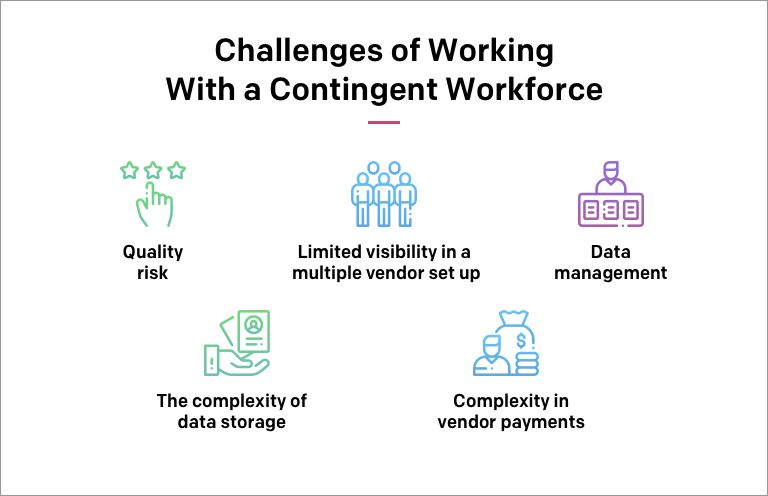
While there are numerous benefits of having a contingent workforce, it also comes with its set of challenges to manage them. Some of these are-
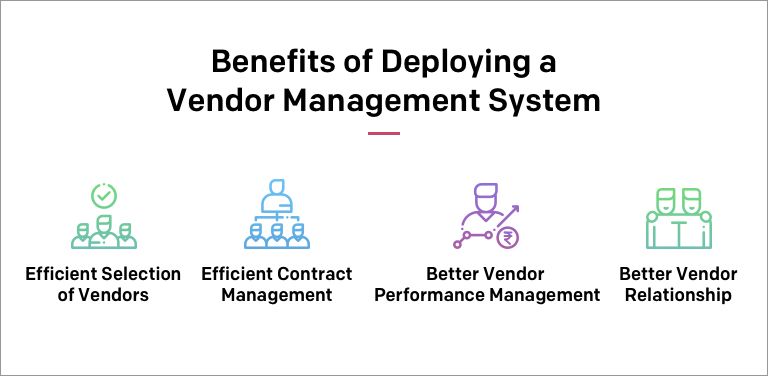
Vendor management can empower enterprises in controlling costs, reducing risks source and manage & deliver value from the contingent workforce. Some of the benefits of employing vendor management systems are –
As the technology landscape evolves, legacy VMS platforms are evolving too by adopting new-age technologies. The ones reshaping the industry are –
ML and AI technology can also help choose the right vendor and assign the right work model, based selected vendor’s work history and also manage legal compliance. ML and AI can also help in building customized dashboards to manage and view vendor data as required.
Mobile platforms can help in managing multiple vendors on-the-go. Vendors and managers can engage with the VMS anytime and from anywhere and log-in relevant information, status, etc. Mobile can help in offering a great user experience to vendors and managers.
With the increase in data volume and data capture fields, technologies like predictive analytics are helping track and measure past behavior and provide predictive analytics on market trends. Besides, it can also help manage vendor data and drive insights from the data.
One example of how predictive analytics augments vendor management is IQN’s cognitive intelligence engine, named ATOM (Automated Talent Ontology Machine). This harnesses predictive analytics to provide real-time recommendations on rates, time-to-fill, labor demand modeling and industry benchmarking
With various forms of freelancer work-force evolving – be it individual or through a staffing firm – the VMS platforms will assist to compare, vet, select and onboard different types of third-party talent side-by-side through integrated systems. The VMS of the future will be about sourcing, provisioning and managing all forms of non-employee talent.
With the rise of the contingent workforce an organization uses, a VMS will need to provide a more secure and efficient platform for risk management. In this scenario, there is an opportunity for the evolution of a blockchain-like architecture ultimately be used to manage this sort of information, tied to a platform-as-a-service (PaaS) model for sharing across diverse VMS and services procurement systems.
Also, technologies like AI/ML, etc. will help to create VMS platforms that not just help organizations with vendor intelligence but business and market intelligence as well. Giving information beyond labor rate intelligence.
As the contingent workforce and employees work side-by-side for enterprises, VMS platforms will help talent teams bridge the gap between managing both and tap into & manage workers with specialized skills and drive value to the businesses.

By Nitin Hegde

RESOURCES
By Abhishek Hegde

By Ivan Pinto
Most conversations about AI delivery focus on what the delivery partner brings to the engagement. The methodology, the toolchain, the engineering practice, the governance standards. We have written elsewhere about what Robosoft brings, and about the standard we have built ARIA around.

By Srinidhi Rao
Most organizations evaluating AI delivery partners are asking the wrong question. They tend to ask which tools a firm uses, when the question that actually matters is what standard the firm is operating to.
A tool is a productivity bump. A standard is what shapes whether the work compounds or stays flat. It is, in our experience, much of why AI projects fail to move past the productivity bump. Firms producing genuinely different outcomes with AI today are doing so because the same operating rules run through every decision, every gate and every phase of the work.
Engineering
Human
Experiences
Let’s get in touch
We craft intuitive digital products that blend user-centric design with robust technology. From UX/UI to full-stack development, we help brands turn ideas into scalable solutions.