



Blog
Software EngineeringAutomotive
22 Oct 2026•7 min read
Most Edge Computing Use Cases Fail Before the First Line of Code Is Written
By Manish Kumar Babul

What we ask our clients and what they receive in return.
Most conversations about AI delivery focus on what the delivery partner brings to the engagement. The methodology, the toolchain, the engineering practice, the governance standards. We have written elsewhere about what Robosoft brings, and about the standard we have built ARIA around.
There is another side to the equation, though, that gets discussed less openly. What working in an AI-native model asks of the client, and what changes when the client engages with it well.
In our experience across two years of building and refining this approach, the client side of the engagement matters as much as the delivery side. The compounding effect we have described elsewhere, the difference between incremental productivity gains and the kind of transformation AI was originally promised to deliver, depends on both sides being set up for it.
This article is about what that looks like in practice.
In traditional software delivery, there was a certain amount of looseness the model itself could absorb. Requirements that were not entirely clear at the start could be clarified during build. Scope changes mid-engagement were expensive, but they were manageable. Engineers interpreted intent and checked back when something needed clarification.
AI-native delivery does not work the same way. The model amplifies whatever it receives. When inputs are precise and stable, the compounding effect across the engagement is real. When inputs are vague or shifting, the same model that compounds good work also compounds the cost of imprecise inputs.
Ambiguity does not vanish in an AI-native model. It moves faster downstream and shows up later, when it is more expensive to address.
What this means in practice is that the client side of the engagement, the clarity of the inputs, the stability of scope through build, the speed of decisions when they are needed, is no longer just a contributing factor. It is what determines whether an AI software development client engagement performs at the level the model is capable of or quietly delivers a fraction of what was possible.
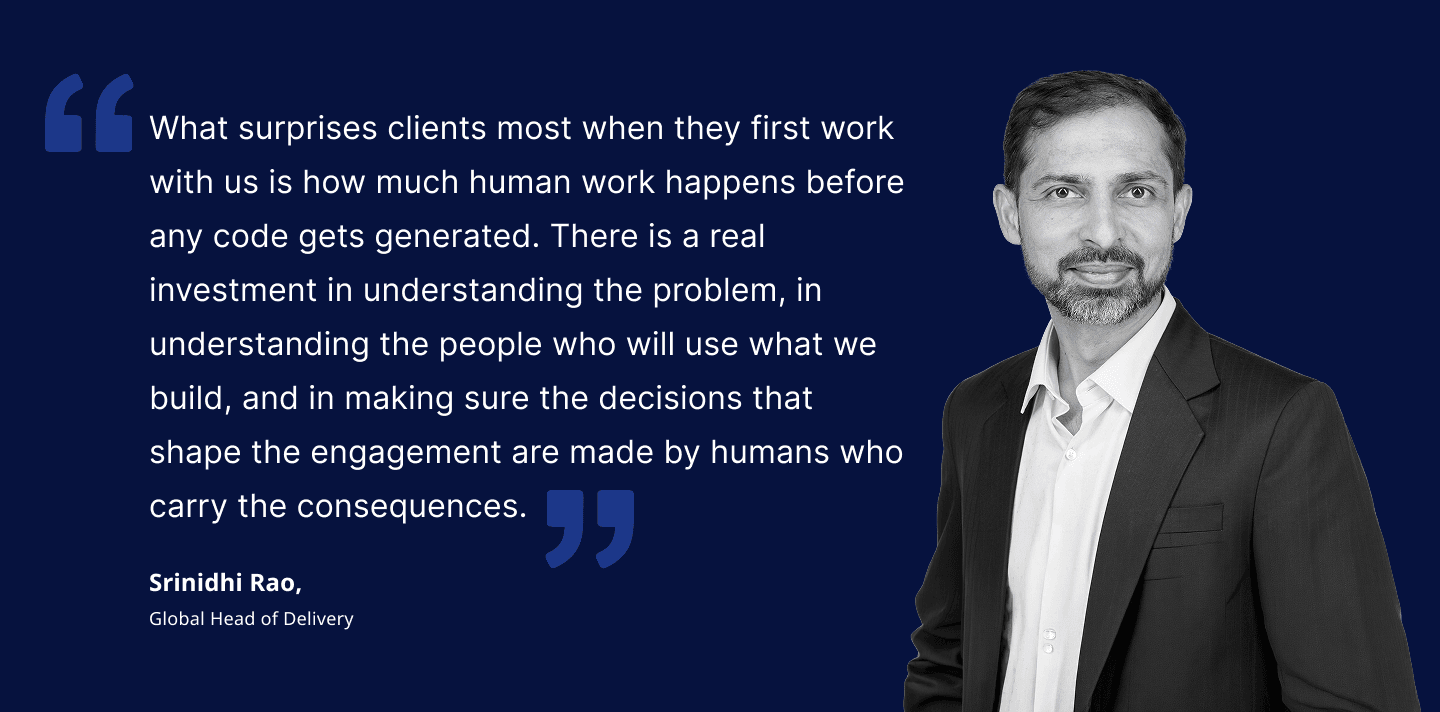
Srinidhi Rao, our Head of Delivery, has observed what surprises clients most when they begin working with us.
The single highest-leverage thing a client can do in an AI-native engagement is invest seriously in the Understand phase.
The instinct most clients bring, understandably, is to move quickly through scoping and into the visible work of building. Discovery can feel like preparation rather than progress. The temptation to compress it is real.
In an AI-native model, this instinct carries a hidden cost. The requirements that emerge from the Understand phase are not documents engineers will interpret later. They are precise inputs that flow into every phase that follows. The clarity of those inputs determines the quality of everything downstream, and the gap between a precise requirement and a vague one widens at every subsequent stage.
The clients who get the most from working with us treat the Understand phase as the investment it actually is. They come prepared with clear goals. They make time for structured working sessions rather than passing the brief over and waiting for the response. They make decisive choices about scope rather than leaving every option open. They surface the constraints they already know about, particularly the ones that are not obvious from outside their organization, early enough to shape the work around them.
What they get in return is an engagement where every downstream phase moves more cleanly and more predictably than they expected when they signed up for it.
Across the five phases of our AI product development process, what we ask of clients changes. None of it is onerous in isolation. Taken together, it represents a different relationship from the traditional commissioning model.
In the Understand phase, we look for clarity of intent and time for structured working sessions. Clients who come into this phase with clear goals, decisive scope, and senior availability for the sessions themselves tend to produce the strongest foundations for the work that follows.
In the Imagine phase, we look for timely feedback on design directions. Delayed feedback in this phase compounds expensively downstream. Constraints that the client knows about, particularly ones that may not be obvious to us, need to surface early rather than emerge mid-build.
In the Build phase, what matters most is stability and decision speed. Requirements that hold steady allow the compounding effect to work as intended. When questions do arise that need a client decision, prompt answers keep the work moving cleanly rather than introducing delay or rework.
In the Prove phase, joint ownership of outcomes matters more than it does in traditional delivery. Acceptance criteria need to be agreed upfront, validated together, with both sides equally invested in whether the work meets the standard.
In the Grow phase, active engagement with production signals is what unlocks the next cycle of work. Clients who treat launch as a milestone rather than as an end, who remain engaged with what the data is showing and open to iterating based on what is actually happening, capture value that other clients leave on the table.
None of this is unreasonable. All of it represents a shift from the way many clients engage with software work by default.
The traditional software engagement is built around a client commissioning a piece of work and reviewing milestones along the way. The model accommodates a relatively hands-off client because the delivery side has been designed to absorb that distance.
AI-native delivery is built around something different. The strongest engagements feel closer to two teams working toward a shared outcome with different areas of expertise. It is, in practice, a co-creation approach to AI development rather than a commissioning one.
Robosoft brings the process, the toolchain, the delivery intelligence and the operating standard. The client brings the domain knowledge, the commercial context, the user understanding, and the decisiveness that keeps the engagement moving. Neither side is sufficient by itself. Together, they produce work that neither could build alone.
This shift is not about asking clients to do more work. It is about asking for a different kind of engagement at specific moments. The total time a client spends on an engagement may not be greater than in a traditional model. The points where their attention is most valuable, however, are different, and getting those moments right is what unlocks the compounding effect across everything else.
Across the engagements we have run on the ARIA standard, four behaviors separate the strongest client partnerships from the rest. Think of them as the enterprise AI implementation best practices that apply to the client side of the work.
The first is defining success before defining features. The conversation we find most useful at the start is not about what the product should do. It is about what a great outcome looks like six months after launch, what would have to be true for the engagement to be considered a success, and how that success will be measured. Features then emerge from that frame, rather than the other way around.
The second is making scope decisions and holding them. In AI-native delivery, mid-build changes carry a downstream cost that traditional models could absorb more easily. The clients who get the most are the ones who make hard scope decisions early and resist the temptation to revisit them once build is underway. Scope stability is not about rigidity. It is about protecting the compounding effect from being broken halfway through.
The third is approving design before build begins. A signed-off specification is what allows intelligence to execute with precision. Clients who treat the design hand-off as a genuine approval gate, rather than as a checkpoint to pass through, see the benefit across every phase that follows.
The fourth is staying engaged after launch. Production signals are the start of the next cycle of work, not the close of the engagement. Clients who remain actively engaged with what their product is doing in the world capture the value of the Grow phase. Clients who disengage at launch leave that value behind.
None of these behaviors are complicated to describe. All of them require a different mindset from the one many clients bring to a software engagement by default.
When both sides bring their best to every phase, the compounding effect becomes visible across the work. Cycles move faster because decisions are not constantly being relitigated. Defects surface earlier and cost less. Releases build on one another rather than resetting from zero. Outcomes start to move the business forward in ways that incremental productivity improvements rarely manage.
The structure, the standard and the delivery intelligence are what we bring. The context, the decisions and the domain expertise are what the client brings. The work that emerges from the partnership is the kind that justifies what AI was originally promised to deliver.
AI-native delivery, done to the standard we work to, asks more of clients at the start than traditional delivery does. It returns considerably more across the engagement and beyond. This is, in short, the AI delivery partnership model we work to.
For organizations ready to engage this way, the conversation about what they bring to the work is as important as the conversation about what we bring. The most useful early conversations we have with prospective clients tend to be about both sides of the engagement, not just one.
That openness about what the model requires from both sides is itself part of what makes it work. We would rather have the honest conversation upfront than discover the mismatch later. And the clients who recognize themselves in this kind of partnership tend to be the ones who get the most from it.
If this sounds like the kind of engagement that would suit how your organization likes to work, we would welcome the conversation.

By Ivan Pinto
Ivan is a Head of Delivery at Robosoft Technologies, leading application development, engineering, and QA teams. With expertise in web technologies (React, Angular, Node.js), mobile platforms (Android, iOS), and CTV & OTT streaming solutions (Samsung, LG, Roku, etc.), he specializes in delivering high-impact software services for global clients. A transformational technical leader and digital strategy expert, Ivan drives enterprise-wide digital and cloud transformations, aligning business objectives with technical execution. Committed to maximizing performance, quality, and ROI, he fosters team growth and continuous innovation to deliver scalable and future-ready technology solutions.

RESOURCES
By Manish Kumar Babul

By Abhishek Hegde

By Abhishek Hegde
Engineering
Human
Experiences
Let’s get in touch
We craft intuitive digital products that blend user-centric design with robust technology. From UX/UI to full-stack development, we help brands turn ideas into scalable solutions.