AI-first software delivery: why most companies sell productivity, not transformation
The difference between AI added to a delivery model and AI built into one, and why the outcomes are not comparable.
When AI arrived in software delivery two years ago, the promise was specific. Cycles would compress meaningfully, quality would improve, and the way software got built would change rather than simply move at a faster pace.
What most organizations are seeing today is productivity improvement. Individual steps in their delivery pipelines have become quicker. Feature throughput has increased. The underlying shape of how their software gets built has remained essentially the same, only operating at a higher tempo.
The gap between what was promised and what arrived is, we think, the conversation worth having more honestly. It is also the gap that separates genuine AI-first software delivery from AI that has simply been added to a process that was never redesigned. Having that conversation openly would require most delivery firms to acknowledge that what they are selling is not always what their clients believed they were buying.
Two practices going by the same name
The reason for the gap comes down to a single confusion in the market. The same language now covers two genuinely different practices.
The more common of the two is AI added to an existing delivery model, which is AI-assisted software engineering in practice. Engineers gain coding assistants. QA teams gain test generators. Analysts gain requirement-structuring tools. The delivery model itself does not change. AI sits inside the pipeline as the pipeline has always existed.
The improvements this produces are real and worth having, but they are bounded. Once each individual step has been accelerated, the gaps between phases remain where they were. Requirements still get interpreted downstream rather than executed directly. Design decisions still need to be relitigated mid-build because they were never precise enough at the outset. Defects continue to surface late in the process because nothing structural has changed when quality is assessed.
A genuine rebuild looks different. This is AI-native software delivery: the delivery model is redesigned from its foundation upward, around how intelligence and people will work together. Requirements are structured so AI can act on them directly without requiring a human to translate them first. Code generation runs at speed under the governance of engineers who carry accountability for what reaches production, with AI code generation best practices applied as a discipline rather than an afterthought. Quality moves through every phase as a continuous thread rather than waiting at the end. Production data feeds back into planning automatically so each cycle is sharper than the one before.
When delivery is built this way, something fundamental shifts. Improvements stop being individual and start feeding one another. Better inputs produce better outputs, which produce sharper signals, which produce better inputs again. Each phase strengthens the phase that follows.
This compounding effect is what AI was always intended to deliver, and it is also why most delivery firms cannot produce it.
Why so few firms have done the work
The honest reason is that rebuilding a delivery model is difficult.
It requires changing how engagements are scoped, how teams are organized, how decisions get made, and where accountability sits. It requires a level of conviction that the rebuild will pay off before the evidence is fully in. And it requires being willing to move more slowly in the short term in order to move meaningfully faster afterward.
Adding AI to what already exists, by comparison, is easier. It sells internally, produces visible improvements quickly, and does not require touching the operating model.
So, most firms add. A few rebuild.
The result is that AI delivery offerings tend to look similar from the outside. The differences only become visible once the engagement is underway, by which point a significant commitment has often been made.
What AI-first software delivery actually produces
A genuinely rebuilt delivery model produces results in three places that an AI-added model cannot reach.
The first is at the beginning of an engagement. When requirements are structured precisely enough for AI to execute directly, a whole category of defect simply does not enter the system. The errors that arise from human interpretation of imprecise inputs disappear, because nothing needs interpreting.
The second is in the middle of the work. AI generates code, tests and structured outputs at speeds that humans cannot match, but every output is reviewed and directed by a person who is accountable for what ships. Intelligence operates at pace, and judgment governs that pace. Neither is asked to substitute for the other.
The third is everywhere the rebuild touches. Production data feeds into the next planning cycle automatically, so each engagement sharpens the next. This is AI development lifecycle management working as a single continuous loop rather than a set of disconnected stages: the intelligence layer compounds across projects in ways that no toolchain can replicate, because what compounds is the standard being held to rather than the tool itself.
These three differences are what produce the outcomes the market promised two years ago. A different pipeline, in other words, rather than a faster version of an existing one.
What clients are actually looking for now
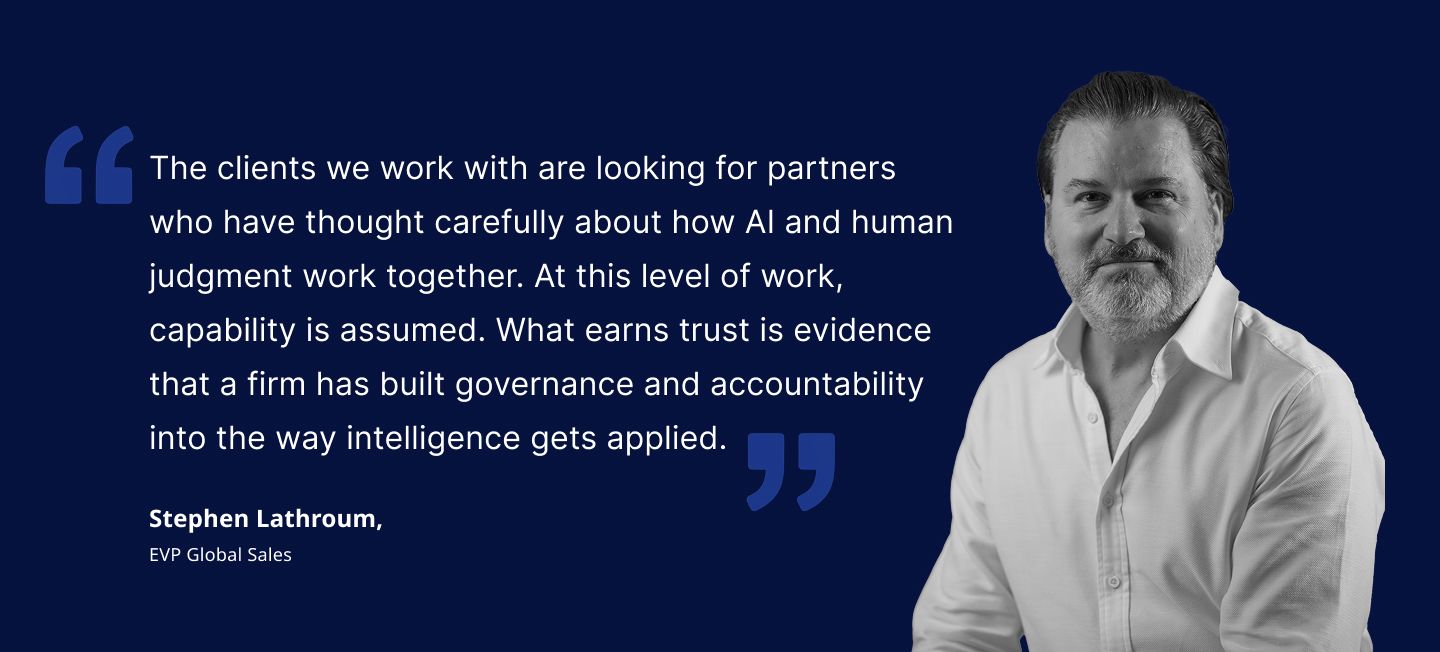
Stephen, our Global Head of Sales, sees clearly what has changed in client conversations.
The question that matters when evaluating an AI delivery firm has little to do with which tools the firm uses. Every credible firm now has access to the same good tools.
The question is whether the delivery model itself has been rebuilt around how intelligence and people work together. Put differently, whether it is genuinely AI-first software delivery or AI-assisted work wearing the same label. Firms that have done that work tend to be able to walk a client through every phase of their delivery specifically, explaining how requirements get structured, how code generation gets governed, how quality runs continuously, and how production feeds back into planning.
Firms that have only added AI to their existing model tend to give more general answers, focused on tools and productivity gains. The structural conversation is harder for them to have because the structure has not actually changed.
The difference between those two kinds of answers is, in practice, the difference between an incremental productivity improvement and the kind of compounding that justifies what AI delivery was sold to clients in the first place.
How Robosoft has chosen
We chose to rebuild rather than add. ARIA is the intelligence brand we have built around that choice, and AI-first software delivery is the standard it holds us to.
Every phase of how we deliver software has been redesigned around how intelligence and our engineers work together. Requirements arrive at the build phase already structured to be agent ready. Code is generated by AI under the governance of engineers who carry accountability for what reaches production. Quality runs through every phase as a continuous thread rather than as a stage at the end. Production performance feeds directly into the next cycle of planning, so what we learn shapes what we build next.
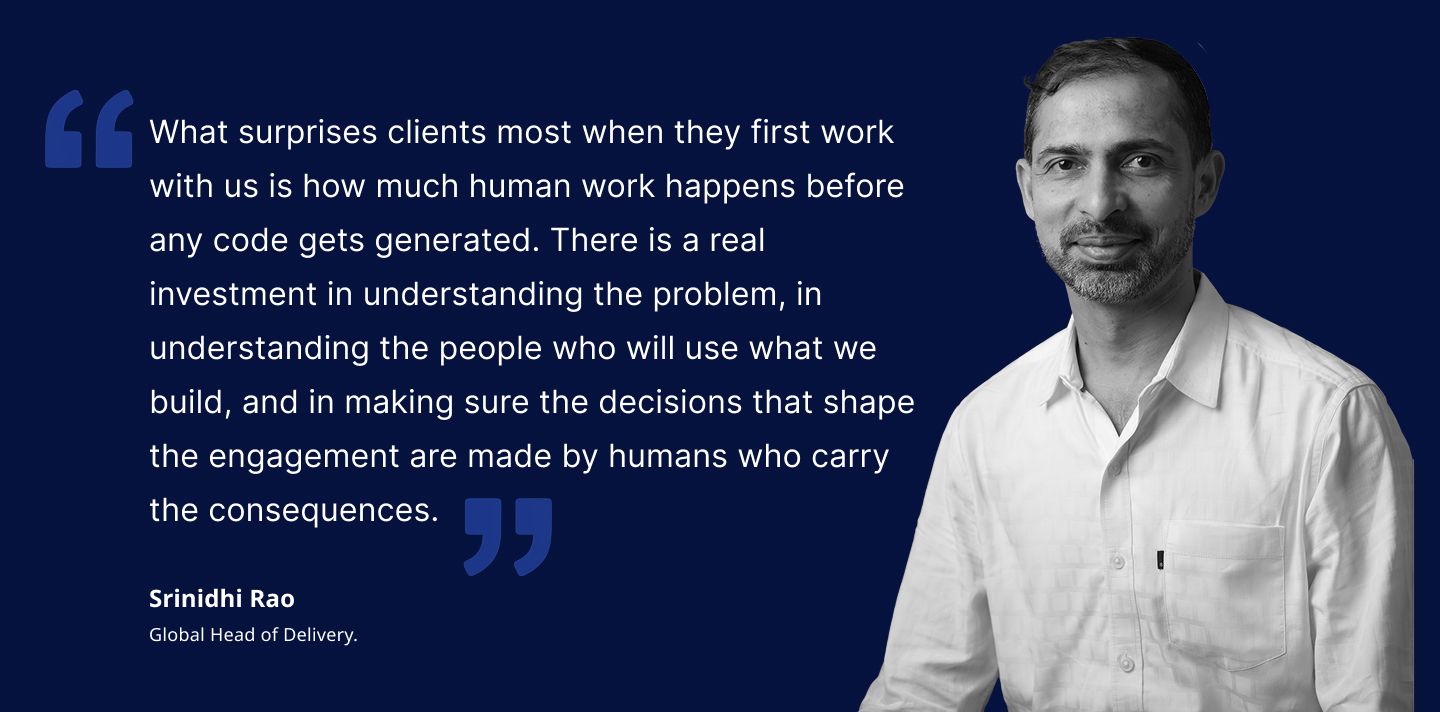
We have also worked to change how we engage with clients, because the compounding effect only takes hold when both sides are set up for it. The front of every engagement now receives significant investment from us. Srinidhi Rao, our Head of Delivery, often describes what this looks like when a client first works with us.
Clients who engage with us this way are not seeing the productivity bump the rest of the market has settled into. They are seeing outcomes that look different because the underlying model is different.
The choice in front of most organizations
Most organizations buying AI delivery today are paying for the productivity model while hoping for the transformation outcome. These are not the same thing, and no amount of better tooling will close the gap between them.
The conversation we think is worth having is about whether the delivery model your partner is using has been rebuilt for AI, or simply equipped with it, which is the difference between AI-first software delivery and AI-assisted delivery by another name. The answer to that question is, in our experience, the answer to whether your AI investment will ever produce what it was meant to.
Manish is the Global Head of Data and Analytics at Robosoft Technologies, bringing over 20 years of expertise in the field. He is a seasoned professional specializing in Business Intelligence, Data Science, Cloud Engineering, and Advanced Analytics. Manish has a proven track record of developing and implementing enterprise-scale Generative AI solutions across a wide range of industries, including retail, e-commerce, telecommunications, finance, and manufacturing. His focus is on leveraging data-driven insights to create solutions that not only meet business objectives but also align seamlessly with IT strategies, ensuring comprehensive and impactful outcomes.
We craft intuitive digital products that blend user-centric design with robust technology. From UX/UI to full-stack development, we help brands turn ideas into scalable solutions.