



Blog
Media & Entertainment
8 Oct 2026•6 min read
The Broadcast Is Not the Test. It Is the Result of the Test.
By Abhishek Hegde

Why human orchestration, not faster automation, is what makes intelligence worth using.
The most consequential decisions in software delivery have always been made by people, and AI has not changed that. Deciding what a product should be, what trade-offs are acceptable, what is good enough to ship and what is not, these are human acts that require judgment and accountability. Intelligence can accelerate almost everything around them, but it cannot do them on its own.
This is the principle we have built ARIA around and it is really a principle about human oversight in AI systems. Intelligence accelerates while people orchestrate, every quality gate is enforced by someone who carries the weight of it, and the loop never closes because production is the start of the next cycle rather than the end of the previous one.
It is a simple position to articulate. But it runs against where most of the industry has been heading, and we believe it explains a great deal about why most software delivery with AI is producing less than it could.
The instinct across most of the industry has been to ask how much of the work AI can take over. Engineers writing less code. Fewer manual tests. Requirements structured by tools rather than people. The implicit goal has been to minimize the human role in delivery and let intelligence run as much of the work as possible.
We came to a different conclusion. The work that AI is genuinely good at is the work that benefits from being unbounded by human bandwidth. Generation, simulation, analysis, monitoring, things that can run continuously and at scale.
The work that humans are uniquely good at is the work that requires judgment. Deciding what matters when several things could matter. Holding standards when there is pressure to relax them. Reading the room of an engagement and knowing whether something is right or whether something is subtly off. These are moments where a person’s accountability for the outcome is the only thing that can actually do the work.
When organizations minimize the human role in delivery, they do not get faster delivery. They get faster execution of decisions that were never thought through carefully. Which, looking honestly at where most enterprise AI delivery has ended up, is exactly the position the industry has arrived at. AI moving quickly in directions that turn out to be slightly wrong, with nobody holding the kind of authority that would have caught it earlier.
The phrase “human in the loop” has been used loosely across the industry. In most AI delivery, it means somebody signing off on an output after the work has already been done. By then, the decisions that mattered have already been made.
Real human orchestration is something different. It is the active work of directing intelligence toward the right problem, in the right form, against the right standards. It is the form human oversight in AI systems takes when it is built into the work rather than added at the end.
In the early phase of an engagement, that means humans deciding what the product is genuinely for and what it must achieve. Intelligence can map options and surface considerations, but the question of which option moves the business forward is one that belongs to people.
In design, it means our designers decide what experience is right for the people who will actually use the product. Intelligence can simulate journeys and generate vARIAtions at a pace no team could match manually, but the empathy that makes a product feel right still comes from a person who understands the user.
In the build, our engineers decide what architecture is sound and what risks are acceptable. AI generates code at speed, but the judgment about whether that code belongs in production is human work. This is human-driven AI development in the literal sense: the machine generates, and the engineer decides.
In quality, someone holds the authority to refuse to ship. AI flags issues continuously, but the decision about whether an issue is acceptable is carried by the person whose name is on the gate.
In production, humans interpret what the data is saying and decide what to do about it. Intelligence monitors at scale, but the meaning of what is being monitored, and the response to it, belongs to people.
Across every phase, the same shape holds. Intelligence does the work that scales, while people do the work that decides.
There is a practical reason for orchestrating delivery this way, separate from the underlying principle.
Decisions made by named, accountable people tend to be made earlier and more cleanly than decisions made by groups, processes or algorithms. When a person owns an outcome, they generally do not defer the hard call. The work moves faster because the decisions that anchor it are not in continual flux.
AI quality gates function properly only when a person has the authority to enforce them. They become aspirational the moment that authority is automated away, because AI can flag issues but cannot refuse to ship. The decision to hold the line on what gets released belongs to someone with the responsibility to live with the consequences.
Production signals become useful only when humans are reading them with judgment. The same data that tells one team nothing tells another team exactly what to build next, because the second team has somebody whose job is to interpret what the signals actually mean.
And compounding becomes possible because the human orchestration layer accumulates judgment over time in ways that intelligence cannot manufacture on its own. Each engagement teaches the people involved something about the work, and that learning shapes how the next engagement runs. The model gets sharper not because of the toolchain but because the people running it become more practiced at orchestrating what intelligence does best.
This is what AI was meant to produce in software delivery. It happens, in our experience, when the human role is at the center of the AI delivery operating model rather than at the periphery.
There is a quiet concern that engineers and designers carry into AI-native software delivery. If AI does more, surely they do less. The role shrinks.
That has not been our experience at all. Our engineers are doing fewer hours of code production and considerably more hours of judgment. They review AI outputs for the subtle errors that matter most, they make architectural calls that intelligence cannot make on its own, and they decide moment to moment what to direct intelligence toward and what to override.
The job has not become smaller. It has become more important. Decisions per day have increased rather than decreased, and the cognitive load has concentrated on the work that actually determines whether a product is right.
The same shift is taking place for our designers, our testers, our product managers and our consultants. None of those roles have been hollowed out. They have concentrated. The work that remains is the work that mattered most all along, and AI has cleared away the work around it that used to take up too much of their time.
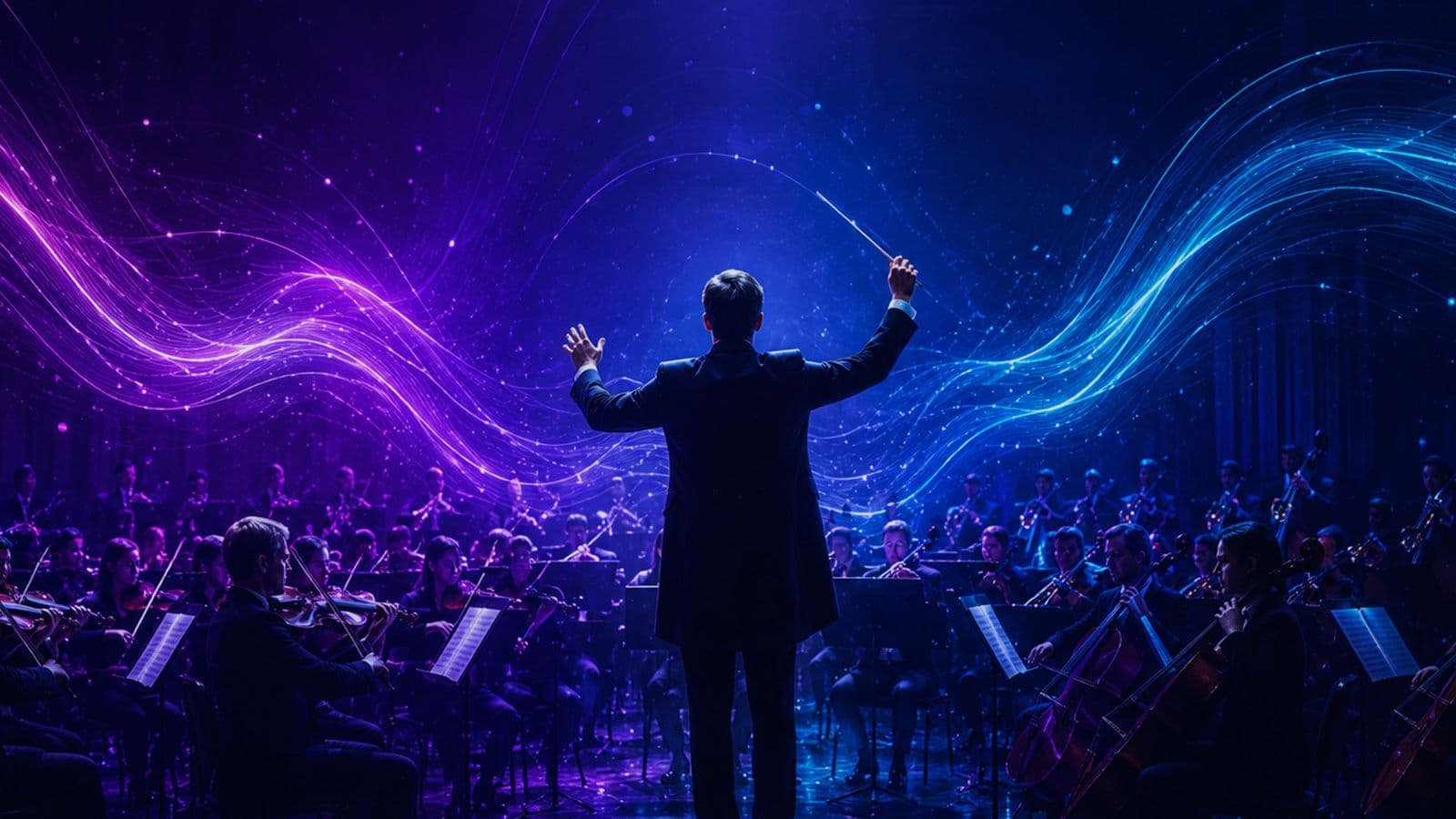
In music, an ARIA is the moment where a single voice carries something the rest of the orchestra is in service of. The other instruments do not stop playing. They play in support of the voice. The conductor does not produce the sound either. The conductor directs what the sound is in service of.
We chose this metaphor for ARIA because it describes what we believe AI delivery should look like. Intelligence fills the room with sound, operating at a scale and pace no individual could produce, but the meaning of what is being created is carried by people. The decisions about what matters belong to them, and the accountability for what is heard sits with them.
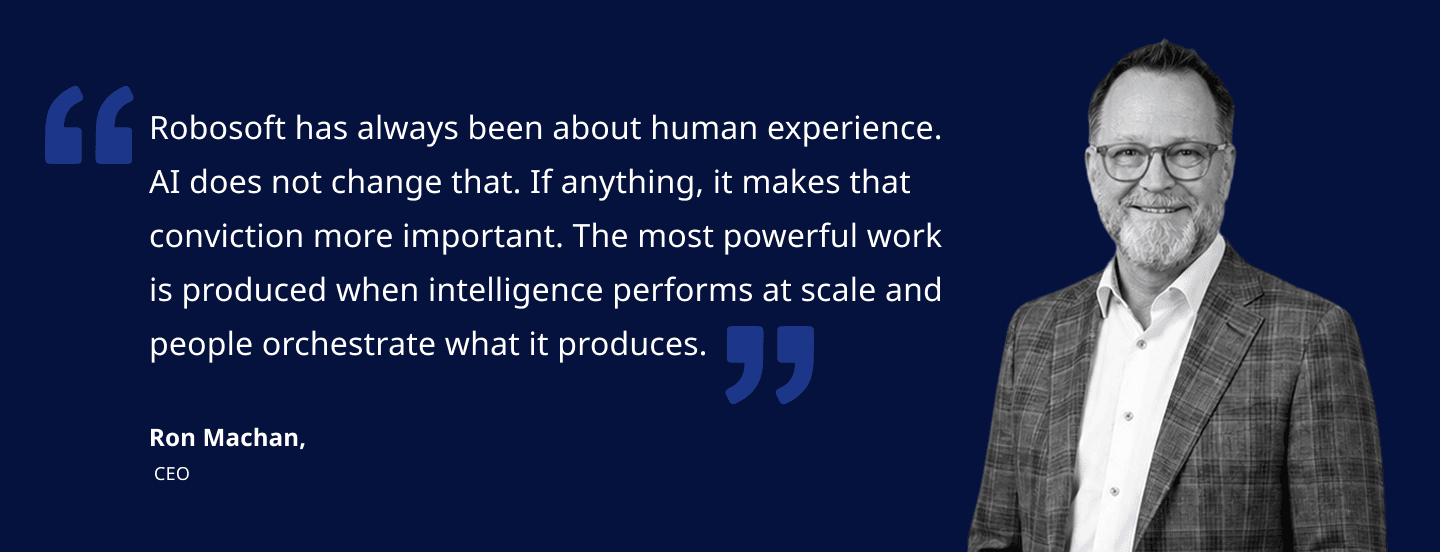
Our CEO, Ron Machan, frames it this way.
This is what makes intelligence worth listening to.
When working with a delivery partner on an AI engagement, the questions worth asking are about the human role rather than the AI role. Who is accountable for each phase? What authority do they carry? Where are the decision points, and what happens when intelligence produces something that is subtly wrong? Who actually holds the judgment about whether something is ready to ship?
When the answers position people as overseers checking AI’s work, the AI software delivery model will plateau. The decisions that matter end up being made too late by people without enough authority to change anything.
When the answers position people at the center, with intelligence amplifying what they decide, the model produces outcomes that look different from anything an AI-added delivery practice can offer.
That is the version of AI delivery we have built around ARIA. We believe it is also the version that will outlast the productivity-bump era, because the work that genuinely matters in software has always belonged to people. Strong human oversight in AI systems is what makes that work worth doing and ARIA is built to make it productive, and as valuable, as it has ever been.

By Srinidhi Rao

RESOURCES
By Abhishek Hegde

By Ivan Pinto
Most conversations about AI delivery focus on what the delivery partner brings to the engagement. The methodology, the toolchain, the engineering practice, the governance standards. We have written elsewhere about what Robosoft brings, and about the standard we have built ARIA around.
By Srinidhi Rao
Most organizations evaluating AI delivery partners are asking the wrong question. They tend to ask which tools a firm uses, when the question that actually matters is what standard the firm is operating to.
A tool is a productivity bump. A standard is what shapes whether the work compounds or stays flat. It is, in our experience, much of why AI projects fail to move past the productivity bump. Firms producing genuinely different outcomes with AI today are doing so because the same operating rules run through every decision, every gate and every phase of the work.
Engineering
Human
Experiences
Let’s get in touch
We craft intuitive digital products that blend user-centric design with robust technology. From UX/UI to full-stack development, we help brands turn ideas into scalable solutions.