



Blog
Media & Entertainment
8 Oct 2026•6 min read
The Broadcast Is Not the Test. It Is the Result of the Test.
By Abhishek Hegde

As digital banking is evolving at a rapid pace, it continues to be a necessity in the modern financial industry. Almost 78% of Americans opt for banking through mobile apps or websites rather than traditional banking—in-person visits to a bank branch. Customers expect seamless, secure, and user-friendly experiences across various digital platforms they use on a day-to-day basis. Technological integration has led to innovative solutions such as Internet banking, mobile wallets, and mobile digital banking. However, with this evolution comes the need for continuous improvement and optimization. The rapid adoption of digital banking solutions has led financial institutions to constantly seek ways to optimize their technology infrastructure and stay ahead in the competitive landscape.
This is where the technology benchmarking of digital banking platforms comes into play, offering financial institutions a way to measure their performance of the digital banking platforms against industry best practices and identify growth opportunities. Comparing the digital banking platform performance, processes, and outcomes against industry best practices – technology benchmarking – is essential. For digital banking platforms, this means assessing aspects such as current IT applications and services—internet and mobile banking applications, mobile wallet services innovation, remittance system efficiency, security protocols, and overall customer experiences.
The banking industry is witnessing an influx of disruptive technologies reshaping customer expectations and experiences. From seamless mobile wallet integrations to swift and secure remittance services, customers now demand convenient, user-friendly, and technologically advanced solutions. Banks or financial institutions must leverage digital banking benchmark analysis for technology enhancements to continuously align their offerings with industry-standard practices by addressing shortcomings and adapting their digital banking platforms to deliver superior customer experiences.
Adapting to the evolving landscape also involves understanding the changing regulatory environment by being vigilant of the latest industry standards. Compliance and security are paramount in the digital banking landscape, and digital banking benchmark analysis for technology on a level with industry standards helps banks and financial institutions ensure that their platforms meet stringent requirements and prevent or mitigate risks effectively.
The methodology of the technology benchmarking of digital banking platforms entails analysis of the existing technology landscape with a focus on the following:
At the core of our approach to the technology benchmarking of digital banking platforms lies the meticulous definition of scope, gathering insights, and providing actionable recommendations. We collaborate closely with our clients to understand their goals and ensure the digital banking benchmark process aligns with their strategic vision. We delve deep into understanding the unique identity of digital banking platform, their customer base, and their expectations.
Our process for evaluating technology benchmarks entails gathering quantitative data via questionnaires and qualitative inputs from key technology stakeholders via stakeholder interviews. By utilizing this approach, we gather essential insights that serve as the bedrock of our digital banking benchmark analysis. We comprehensively analyze the technological facets and operational complexities to view the existing ecosystem against the industry’s best practices. This perspective allows us to provide valuable observations and benchmarking recommendations that empower our clients to make well-informed decisions.
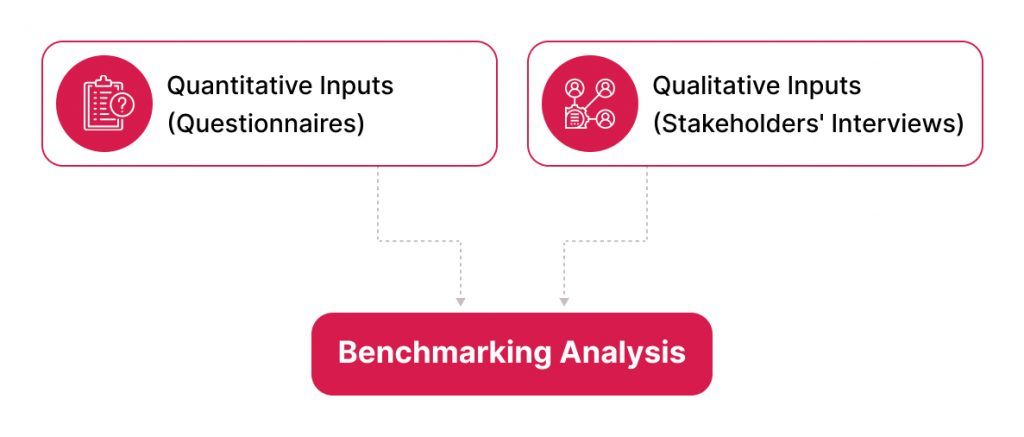
For one of our clients with the requirement of technology benchmarking for digital banking platforms, our methodology involved these facets:
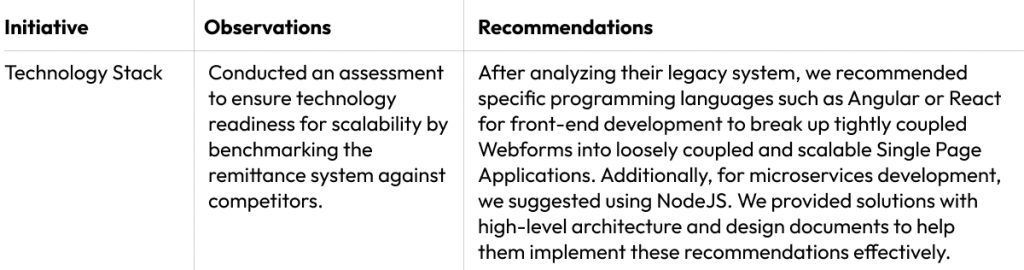
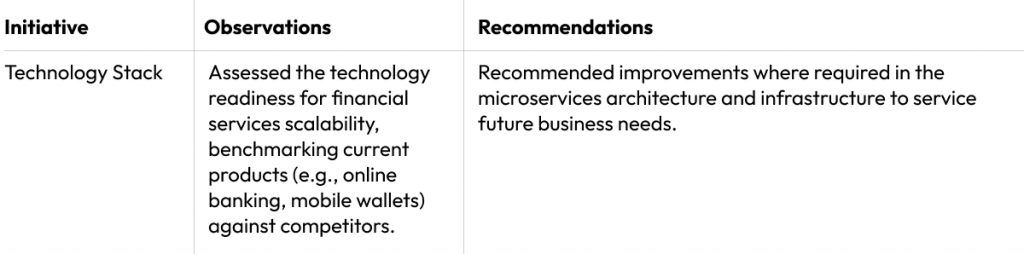
We assessed the technology readiness of the existing IT applications to support the financial services businesses’ long-run scalability and ensure alignment of IT to business strategies. This involved benchmarking the current products or services (online banking, mobile digital banking, and mobile wallets) and the technology landscape against competitors in targeted geographies. Also, the assessment included determining the future roadmap in terms of the technology stack for the remittance application.
Remittance Application: Observations & Recommendations
Digital Banking Suite (Mobile Wallet, Online and Mobile Digital Banking): Observations & Recommendations
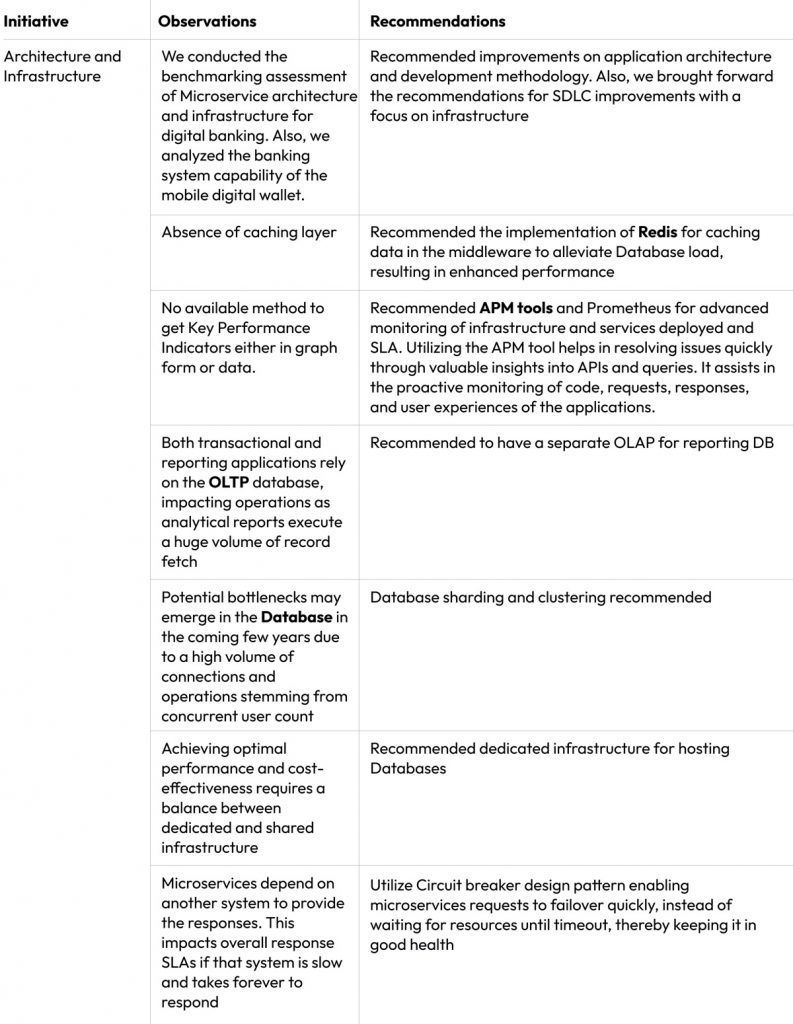
At this stage, our digital banking benchmark analysis process involved a holistic assessment of the current architecture and infrastructure for remittance application, mobile digital wallets, and digital banking. Through this evaluation, we focused on understanding the performance benchmarks exhibited by these systems and applications, enabling us to identify potential areas for enhancement and optimization.
Remittance Application: Observations & Recommendations

Digital Banking Suite (Mobile Wallet, Online and Mobile Digital Banking): Observations & Recommendations
We conducted digital banking benchmark analysis to measure the database design within the technological framework for digital banking platforms. Our assessment involved the industry’s best practices by comprehensively exploring various facets that collectively define the structure and efficiency of the existing database design.
We assessed the key aspects such as indexing strategies, query optimization, archive database, partitioning of tables, and database design revamp suitable for microservices. We could gauge the database’s responsiveness, reliability, and overall performance by focusing on these components.
Remittance Application, Mobile Wallet, Online and Mobile Digital Banking: Observations & Recommendations
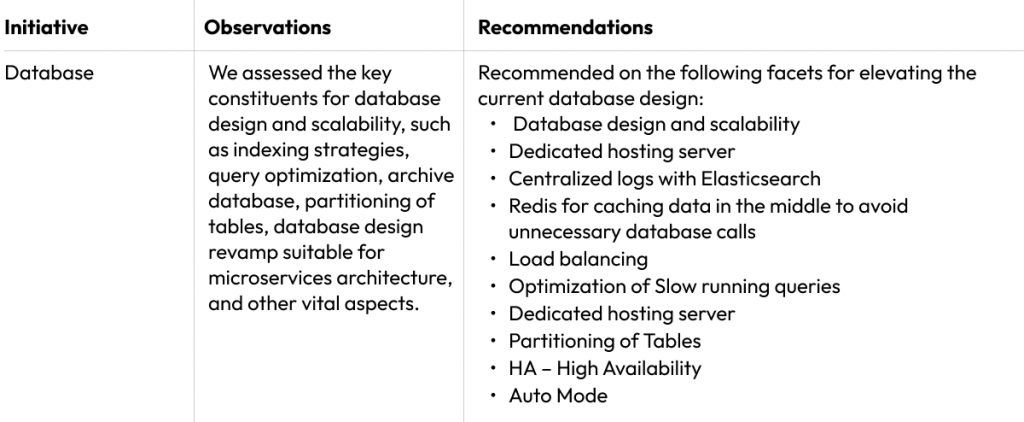
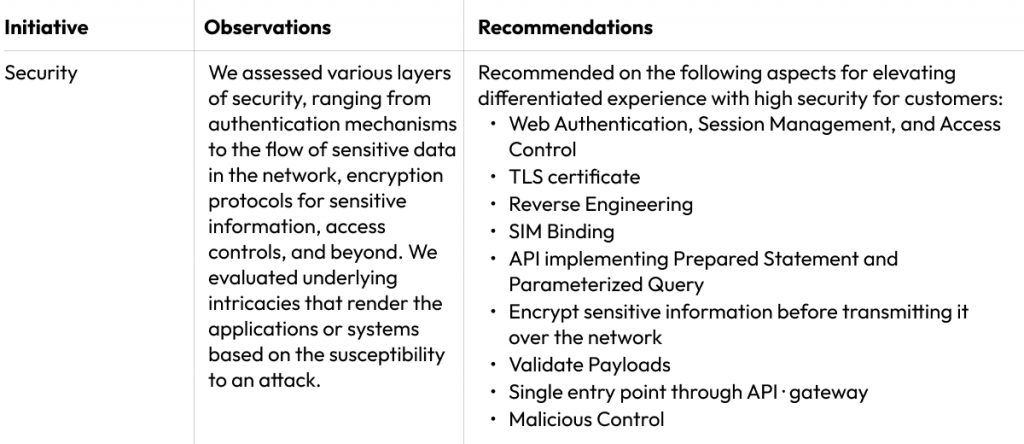
At this stage, our digital banking benchmark assessment for security aspects involved the evaluation of the vulnerabilities or risks of the applications with severity classification for each vulnerability. We conducted the digital banking benchmark analysis to examine the security aspects and pinpoint potential vulnerabilities that could be exploited in the form of attacks, breaches, or unauthorized access attempts.
In this process, we ensured the safety and security of the systems and applications. We utilized industry best practices to assess and fortify our systems against potential threats, upholding high security and safeguarding sensitive data, financial transactions, and user information.
Remittance Application, Mobile Wallet, Online and Mobile Digital Banking: Observations & Recommendations
The digital banking industry is constantly changing and characterized by disruption. To keep up, financial institutions need to implement the best practices for the technology benchmarking of digital banking platforms. This allows them to transcend conventional boundaries, innovate, and achieve excellence in digital banking.
Financial institutions can use digital banking benchmark analysis for technology enhancements of their digital banking platforms to create solutions that meet current customer expectations while also being resilient and adaptable to future disruptions. This approach ensures that the platforms are future-proof and can continue to provide quality service to their customers.

By Mahesh Kumar

RESOURCES
By Abhishek Hegde

By Ivan Pinto
Most conversations about AI delivery focus on what the delivery partner brings to the engagement. The methodology, the toolchain, the engineering practice, the governance standards. We have written elsewhere about what Robosoft brings, and about the standard we have built ARIA around.

By Srinidhi Rao
Most organizations evaluating AI delivery partners are asking the wrong question. They tend to ask which tools a firm uses, when the question that actually matters is what standard the firm is operating to.
A tool is a productivity bump. A standard is what shapes whether the work compounds or stays flat. It is, in our experience, much of why AI projects fail to move past the productivity bump. Firms producing genuinely different outcomes with AI today are doing so because the same operating rules run through every decision, every gate and every phase of the work.
Engineering
Human
Experiences
Let’s get in touch
We craft intuitive digital products that blend user-centric design with robust technology. From UX/UI to full-stack development, we help brands turn ideas into scalable solutions.