Most businesses start a cloud migration because their current infrastructure is slowing them down. Servers that take too long to scale. Systems that require manual patching and maintenance. Storage costs that keep rising without clear return. The case for moving is usually straightforward. The execution is where enterprise cloud migration strategies are tested.
According to IDC's 2025 survey, 43 percent of enterprises experienced delays or cloud migration cost overruns, with the average overrun exceeding 35 percent of the original budget. These are not failures caused by the technology. They are caused by how migration was planned, what was missed during discovery, and decisions pushed too late into the program.
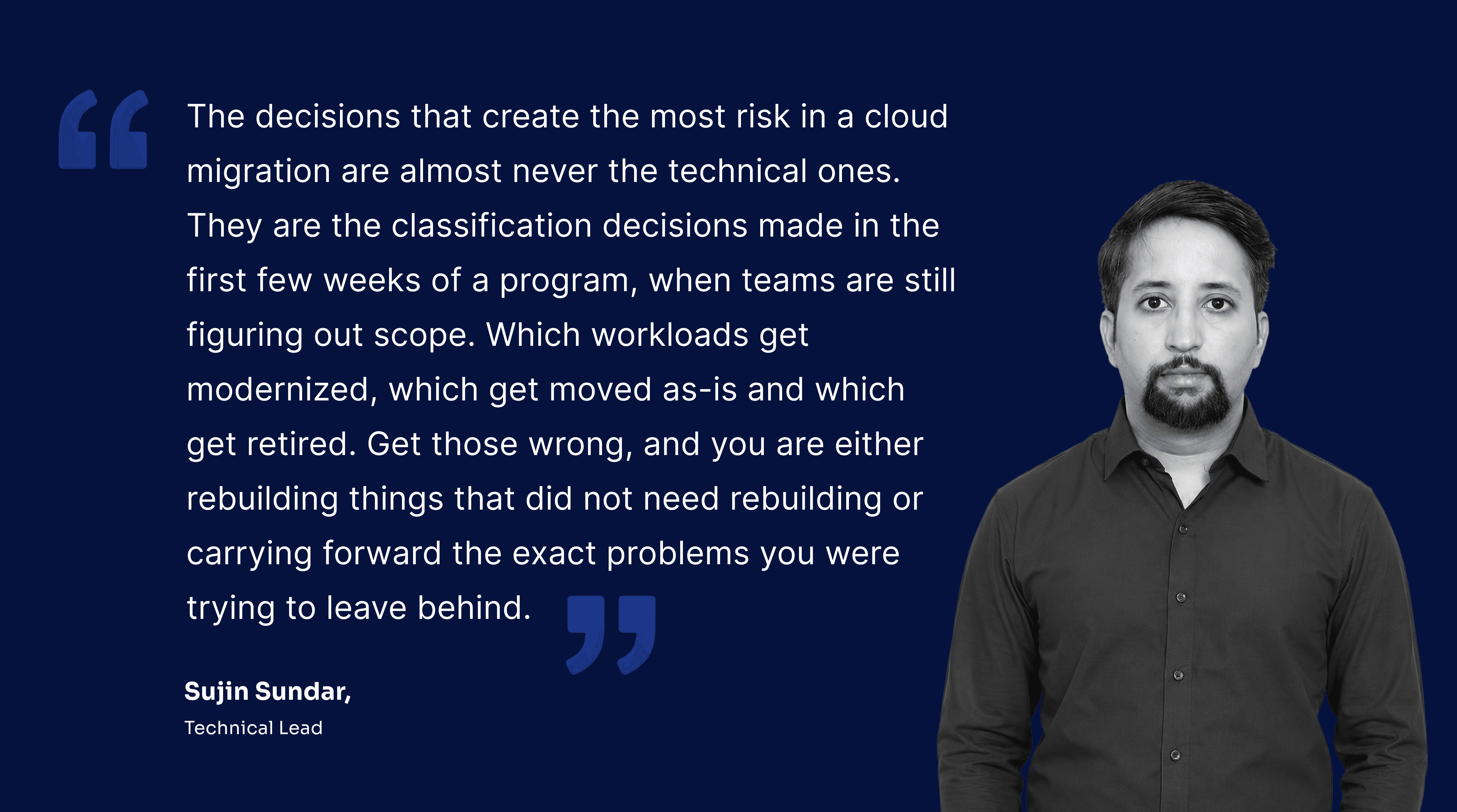
That is the pattern behind most migration difficulties. Not technical failure. Early decisions made with insufficient rigor, whose consequences only become visible months later when they are significantly more expensive to correct.
The first decision: what each workload actually needs
Not every system needs to be rebuilt to benefit from the cloud. Some applications are stable, serve a predictable user base, and have no meaningful architectural problems worth solving. For these, a lift and shift cloud migration approach, moving the existing setup to cloud infrastructure without restructuring, is often the right call. It is faster, lower risk, and still delivers real benefits: elastic capacity, managed backups, better uptime, and a stronger security baseline than most on-premise environments can sustain.
When Robosoft migrated a research portal for a leading US university to AWS, that was the approach the team took. The application was stable, the user base well defined, and the priority was continuity. The migration completed without service disruption. In a second phase, frequently invoked functions were separated into microservices with auto-scaling, allowing modern third-party integrations without touching the core legacy service and reducing the compute overhead of the monolithic system in the process.
Other systems, those serving large customer volumes, processing high transaction loads, or integrating across multiple platforms, need more deliberate architectural thinking. Moving these as-is risks preserving the existing problems rather than solving them. The migration is the right moment to address how the system is built, because doing so after go-live is significantly more expensive and disruptive.
The most common mistake enterprises make is applying the same approach across all workloads regardless of what each one requires. Getting this classification right before the program begins is what separates migrations that deliver value from migrations that create a second round of work.
What is not documented will cause downtime
Unplanned downtime during a cloud migration almost always traces back to something that was not documented before the cutover. An application that looked self-contained calls a service buried three layers deep. A database migration breaks a reporting process nobody thought to flag. A scheduling job stops running because it was hardcoded to an IP address that no longer exists.
These are not unusual edge cases. They are the predictable result of migrating systems without a thorough dependency map. Effective cloud migration risk management starts here: building a map covering every integration, every data feed, every downstream process before the migration sequence is set. It adds time at the front. It removes considerably more time and cost from the middle.
Rollback planning deserves the same attention. Most migration teams plan to reverse course if something goes wrong, but few define the specific conditions under which they will do so before the cutover begins. When a problem surfaces mid-migration, the decision needs to be made quickly against agreed criteria, not under pressure without a clear threshold.
Data integrity is not a final check
When a migration involves moving data between systems with different structures, or consolidating data from separate environments into one, the risk of integrity gaps is significant. Records that appear complete during transfer may be missing references, contain format mismatches, or fail reconciliation checks that only surface after go-live.
Robosoft encountered this directly during the post-acquisition migration of L&T Investment Management onto HSBC Mutual Fund's Google Cloud Platform. The engagement involved consolidating customer accounts, scheme records, and transaction histories across two systems while implementing regulatory compliance updates in parallel. Building integrity checks directly into the migration process and validating continuously throughout the transfer, rather than running a single check at the end, enabled over 10,000 customer accounts to transition without service interruption.
Data validation should be a first-class workstream from the start: reconciliation criteria defined before any data moves, checked continuously, and owned by someone with the authority to stop the migration if the checks fail.
Security built in is cheaper than security retrofitted
Security is frequently deferred until after a migration is stable. The intention is sensible: complete the move first, harden the environment afterwards. The problem is that hardening after go-live means reworking decisions that have already been deployed, with a system running in production at a weaker posture than it should.
Identity and access management, network segmentation, encryption at rest and in transit, and audit logging are architectural decisions. They belong in the target architecture design from the beginning, not the post-migration backlog. The same applies to backup configuration. Establishing automated backup schedules, retention policies, and recovery validation during the migration itself is straightforward. Establishing equivalent coverage six months after go-live, once the migration team has moved on, costs considerably more in both time and risk.
Cost is shaped by technical decisions, not finance reviews
Cloud spend is directly determined by the technical choices made during migration: how instances are sized, how storage is configured, how non-production environments are managed, and how resources are tagged for cost allocation. When cost governance is deferred to a post-migration finance review, the first billing cycle often becomes a correction exercise.
Organizations that embed tagging standards, rightsizing practices, and non-production shutdown policies into the migration itself are in a much stronger position to achieve the cost efficiency that justified the program in the first place.
The decisions that matter most happen first
A well-executed enterprise cloud migration strategy looks unremarkable from the outside. Systems move, users continue working, and the business gains the infrastructure it was looking for. That outcome is not the result of smooth technology. It is the result of decisions made well before the first workload moves.
Workload classification, dependency mapping, data integrity planning, security architecture, and cost governance are not workstreams to schedule once the program is underway. They are the program. Get them right at the start and the migration reflects it. Defer them and the program will find ways to remind you.
Robosoft has helped enterprises plan and execute cloud migrations across a range of industries, scales, and compliance requirements. If your organization is preparing for a migration, tell us what your workloads, timelines, and risk profile actually need before anything moves.