



Blog
Software EngineeringAutomotive
22 Oct 2026•7 min read
Most Edge Computing Use Cases Fail Before the First Line of Code Is Written
By Manish Kumar Babul

In a Jan 2024 survey by Everest Group, 68% of CIOs pointed out budget concerns as a major hurdle in kickstarting or scaling their generative AI investments. Just like estimating costs for legacy software, getting the budget right is crucial for generative AI projects. Misjudging estimates can lead to significant time loss and complications with resource management.
Before diving in, it’s essential to ask: Is it worth making generative AI investments now, despite the risks and the ever-changing landscape, or should we wait?
Simple answer: Decide based on risk and the ease of implementation. It’s evident that generative AI is going to disrupt numerous industries. This technology isn’t just about doing things faster; it’s about opening new doors in product development, customer engagement, and internal operations. When we speak with tech leaders, they tell us about the number of use cases pitched by their teams. However, identifying the most promising generative AI idea to pursue can be a maze in itself.
This blog presents a practical approach to estimating the cost of generative AI projects. We’ll walk you through picking the right use cases, LLM providers, pricing models and calculations. The goal is to guide you through the GenAI journey from dream to reality.
When selecting an LLM, the main concern is budget. LLMs can be quite expensive, so choosing one that fits your budget is essential. One factor to consider is the number of parameters in the LLM. Why does this matter? Well, the number of parameters provides an estimate of both the cost and the speed of the model’s performance. Generally, more parameters mean higher costs and slower processing times. However, it’s important to note that a model’s speed and performance are influenced by various factors beyond just the number of parameters. However, for this article’s purpose, consider that it provides a basic estimate of what a model can do.
There are three main types of LLMs: encoder-only, encoder-decoder, and decoder-only.
At Robosoft, we’ve developed an approach to solving client problems. We carefully choose models tailored to the use case, considering users, their needs, and how to shape interactions. Then, we create a benchmark, including cost estimates. We compare four or five models, analyze the results, and select the top one or two that stand out. Afterward, we fine-tune the chosen model to match clients’ preferences. It’s a complex process, not simple math, but we use data to understand and solve the problem.
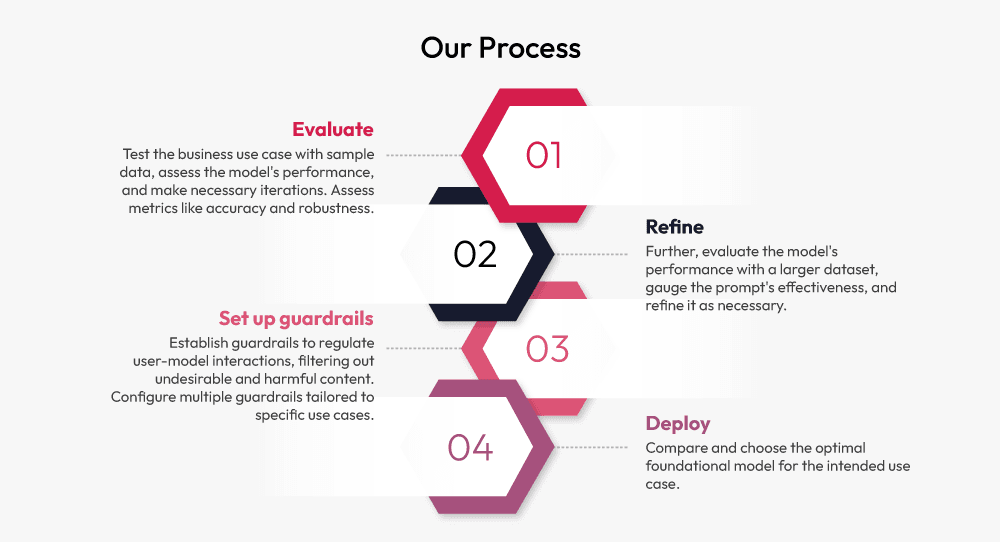
Start with smaller, low-risk projects that help your team learn or boost productivity. Generative AI relies heavily on good data quality and diversity. So, strengthen your data infrastructure by kicking off smaller projects now, ensuring readiness for bigger AI tasks later.
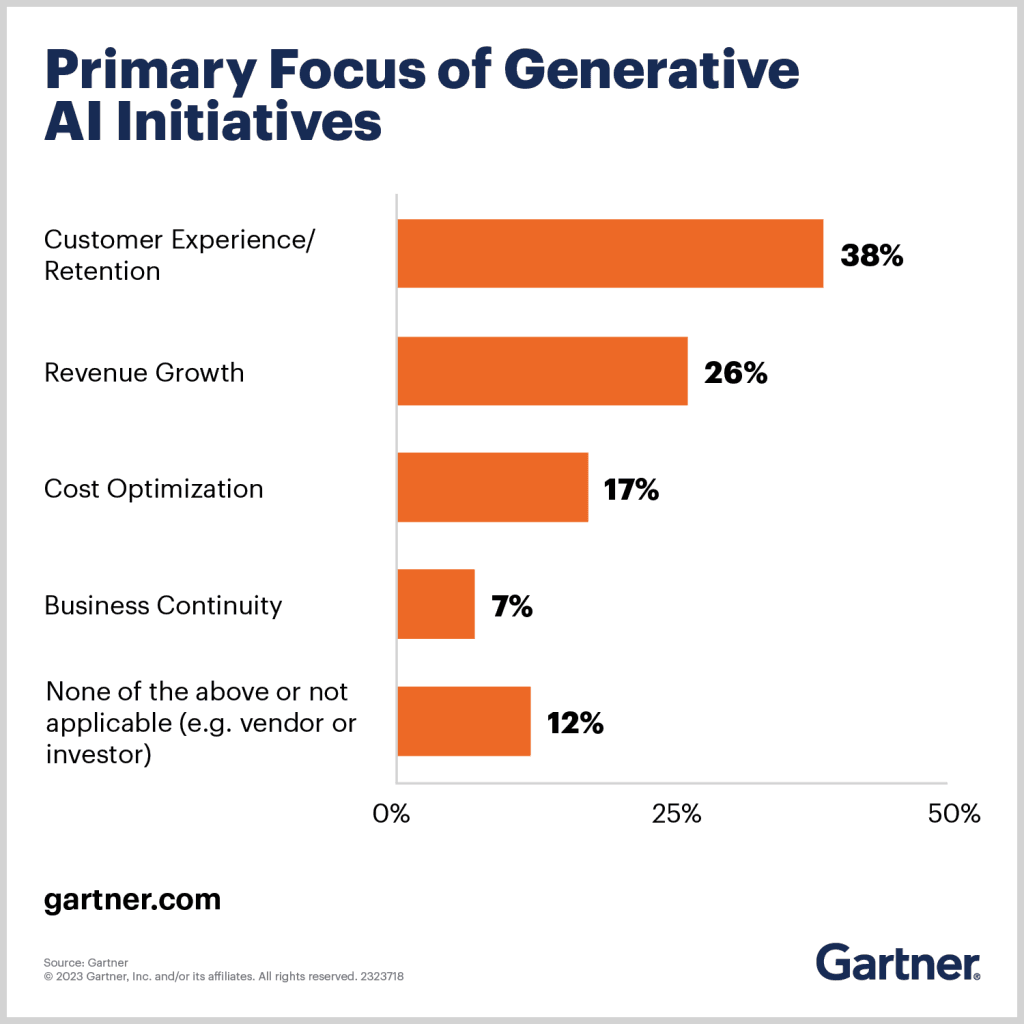
In a recent Gartner survey of over 2,500 executives, 38% reported that their primary goal for investing in generative AI is to enhance customer experience and retention. Following this, 26% aimed for revenue growth, 17% focused on cost optimization, and 7% prioritized business continuity.
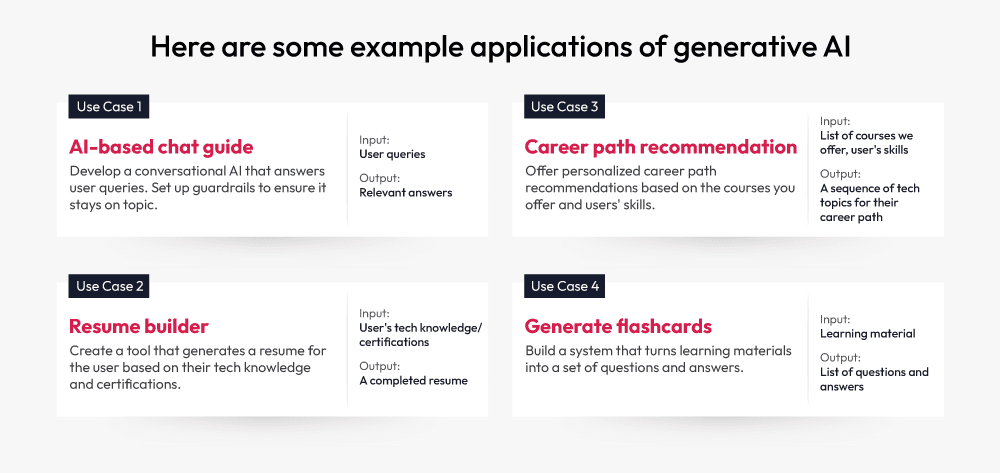 Begin with these kinds of smaller projects. It will help you get your feet wet with generative AI while keeping risks low and setting you up for bigger things in the future.
There are several methods for implementing GenAI, including RAG, Zero Shot, One Shot, and Fine Tuning. These are effective strategies that can be applied independently or combined to enhance LLM performance based on task specifics, data availability, and resources. Consider them as essential tools in your toolkit. Depending on the specific problem you’re tackling, you can select the most fitting method for the task at hand.
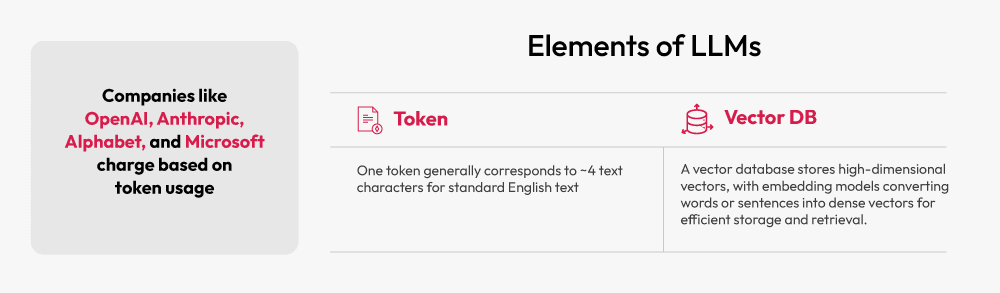
Once you choose the implementation method, you must decide LLM service (refer table 1 below) and then work on prompt engineering — that’s part of software engineering.
Commercial GenAI products work on a pay-as-you-go basis, but it’s tricky to predict their usage. When building new products and platforms, especially in the early stages of new technologies, it’s risky to rely on just one provider.
For example, if your app serves thousands of users every day, your cloud computing bill can skyrocket. Instead, we can achieve similar or better results using a mix of smaller, more efficient models at lower cost. We can train and fine-tune these models to perform specific tasks, which can be more cost-effective for niche applications. 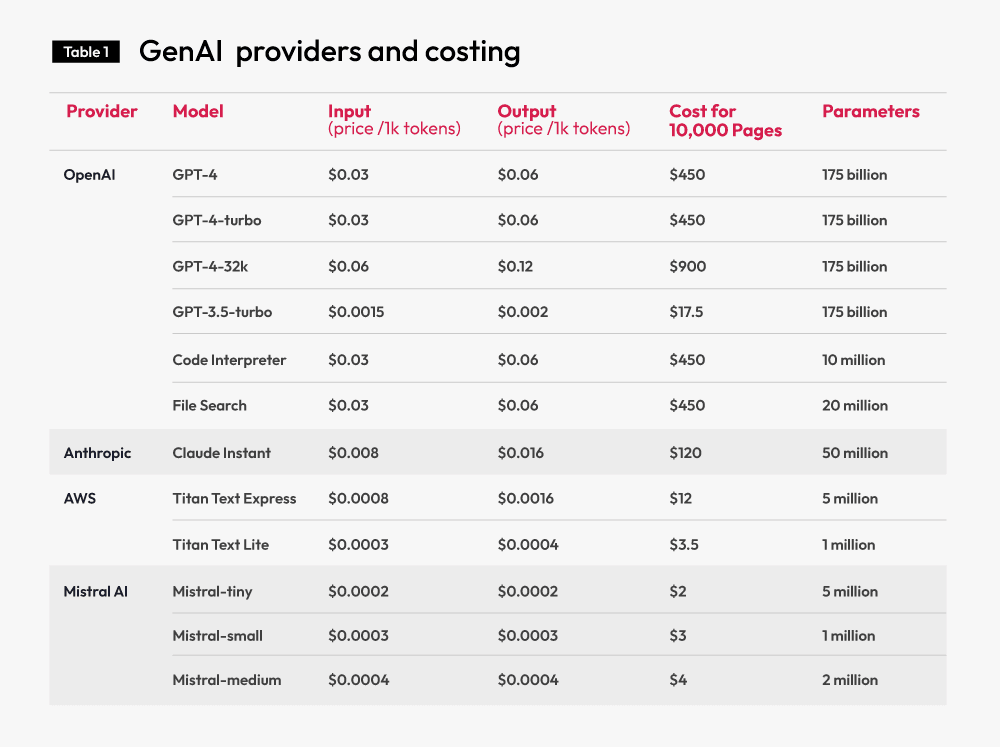 In the above table 1, “model accuracy” estimates are not included because they differ based on scenarios and cannot be quantified. Also note that the cost may vary. This is the current (as of July 2024) cost listed on the provider’s website.
Let’s consider typical pricing for the GPT-4 model for the below use cases.
Here are some assumptions:
When a candidate generates a resume using AI, the system collects basic information about work and qualifications, which equates to roughly 150 input tokens (about 30 lines of text). The output, including candidate details and work history, is typically around 300 tokens. This forms the basis for the input and output token calculations in the example below.
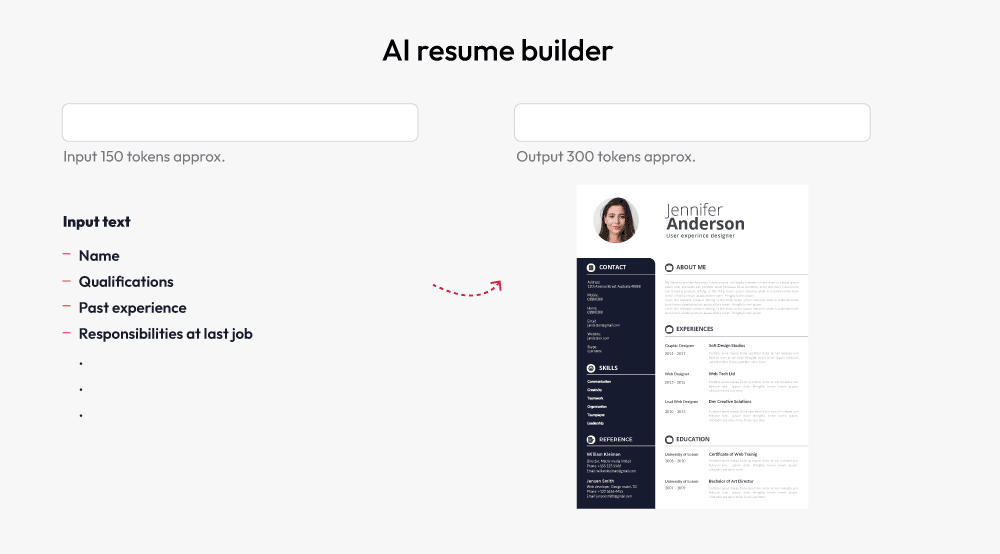
Let’s break down the cost.
Total Input Tokens:
Total Output Tokens:
Input Cost:
Output Cost:
Total Monthly Cost:
Total Cost = Input Cost + Output Cost = $45 + $180 = $225
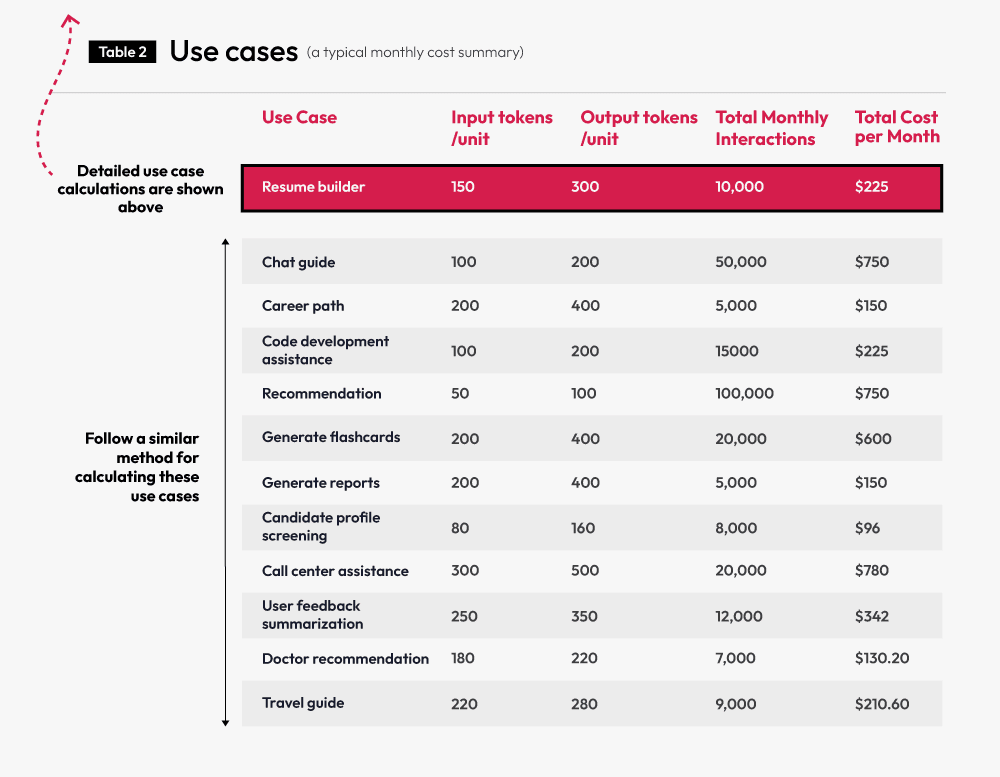
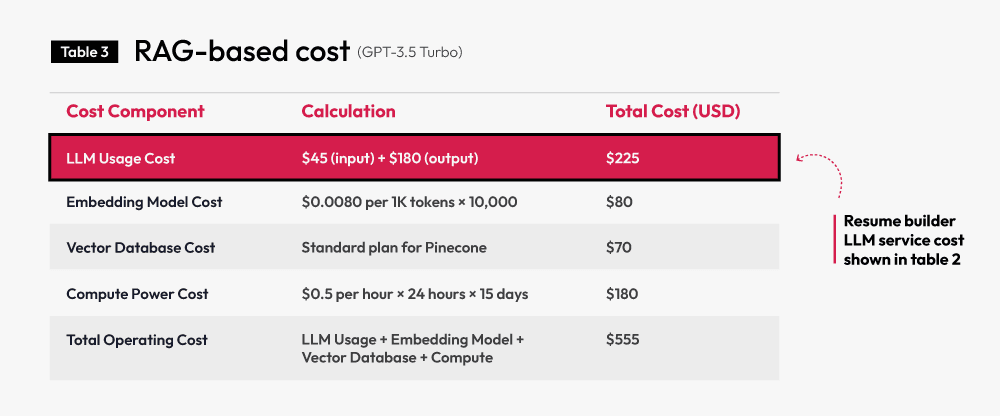
Retrieval Augmented Generation (RAG) is a powerful AI framework that integrates information retrieval with a foundational LLM to generate text. In the case of resume builder use case, RAG retrieves relevant data based on the latest information without the need for retraining or fine-tuning. By leveraging RAG, we can ensure the generated resumes are accurate and up-to-date, significantly enhancing the quality of responses.
It involves adjusting a pre-trained AI model to better fit specific tasks or datasets, which requires additional computational power and training tokens, increasing overall costs. For example, if we fine-tune the Resume Builder model to better understand industry-specific terminology or unique resume formats, this process will demand more resources and time compared to using the base model. Therefore, we are not including the cost for this use case.
To calculate the actual cost, follow these steps:
The rough estimate would be somewhere between $150,000 to $2,50,000. These are just the ballpark figures. The costs may vary depending on your needs, LLM service, location, and market condition. It’s advisable to talk to our GenAI experts for a precise estimate. Also, keep an eye on the prices of hardware and cloud services because they keep updating.
You can check out some of our successful enterprise projects here.
At Robosoft, we believe in data democratization—making information and data insights available to everyone in an organization, regardless of their technical skills. A recent survey shows that 32% of organizations already use generative AI for analytics. We’ve developed self-service business intelligence (BI) solutions and AI-based augmented analytics tools for big players in retail, healthcare, BFSI, Edtech, and media and entertainment. With generative AI, you can also lower data analytics costs by avoiding the need to train AI models from the ground up.
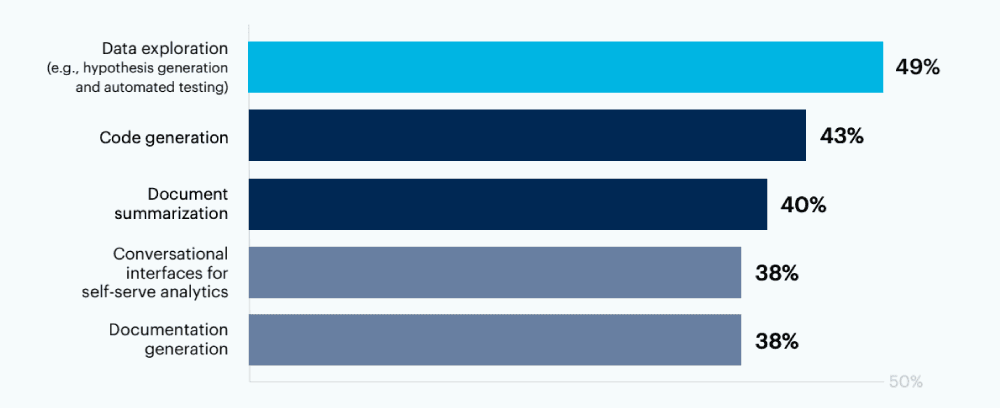
Image source: Gartner (How your Data & Analytics function using GenAI)
Generative AI investments aren’t just about quick financial gains; they require a solid data foundation. Deploying generative AI with poor or biased data can lead to more than just inaccurate results. For instance, if a company uses biased data in its hiring process, say gender or race, it could discriminate against certain people. In a resume-builder scenario, this biased data might incorrectly label a user, damaging a company’s reputation, causing compliance issues, and raising concerns among investors.
While we write this article, a lot is changing. Our knowledge about generative AI and what it can do might differ. However, our intent of providing value to customers and driving change prevails.

By Manish Kumar Babul

RESOURCES
By Manish Kumar Babul

By Abhishek Hegde

By Abhishek Hegde
Engineering
Human
Experiences
Let’s get in touch
We craft intuitive digital products that blend user-centric design with robust technology. From UX/UI to full-stack development, we help brands turn ideas into scalable solutions.