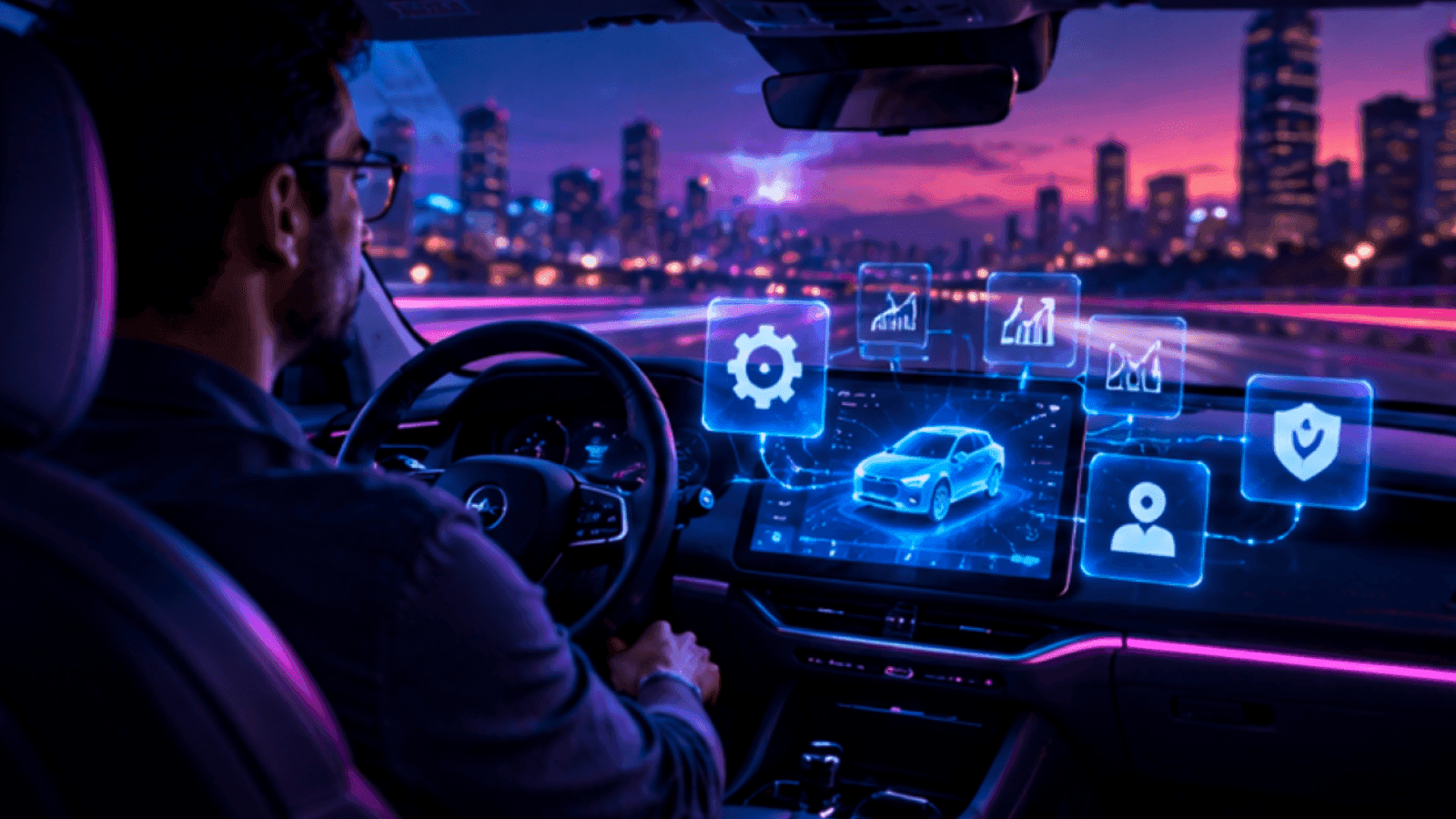
For over a century, the automotive industry perfected one discipline: shipping hardware at scale. From Ford's moving assembly line to Toyota's lean production system, the industry turned vehicle programs into repeatable, refinable machines.
Launch. Improve the launch. Repeat.
Software-defined vehicles do not reward that playbook. They expose its limits.
A modern vehicle is no longer a finished product when it leaves the factory. It is a program that must be updated, secured, and meaningfully improved across a lifecycle that stretches years beyond the point of sale. The competitive question has shifted accordingly. It is no longer only about who launches the best car. It is about who can keep it getting better, safely and consistently, across millions of vehicles in the field.
That is the decade OEMs are now entering. Most are not fully prepared for what it demands.
The changing mindset: from hardware-first to software-defined vehicle
Cars have always contained software. But a software-defined vehicle is a different proposition. Software becomes the primary driver of what customers experience, what differentiates one manufacturer from another, and what determines whether ownership feels static or alive.
Owners encounter this in ordinary moments. A feature arrives overnight that was not there at purchase. An app explains range and charging in plain language. The interface feels closer to a device than a dashboard. None of this happens by accident, and none of it is possible without rebuilding the foundations beneath it.
OEMs are restructuring how vehicles are wired and computed to make continuous software delivery viable. Dozens of isolated electronic control units (ECU) are giving way to centralized compute and zonal architectures - the backbone of a coherent software defined vehicle architecture - a structural change that makes a scalable, updatable software layer possible. Volkswagen's internal restructuring around its software platform is one of the clearest signals in the industry of how central this has become. It is not a technology project. It is a survival decision.
The implications run further than engineering. Virtual development environments are accelerating launches. Connected ownership tools extend the manufacturer-customer relationship well beyond the forecourt. A software-defined vehicle is not just manufactured. It is operated continuously, long after handover.
SDV Challenges in Automotive: Why the traditional development model breaks
The conventional vehicle development cycle was built for physical products: design, freeze, test, ship. It is a rational process when the product is essentially complete at launch. Software-defined vehicles are not complete at launch. They are beginning.
That difference exposes three failure points that traditional processes were never designed to handle.
Together, they represent the software-defined vehicle challenges that consistently separate manufacturers capable of the transition from those who fall behind.
The first is integration timing. In hardware development, integrating late creates delays. In software, it creates architectural failures - system-level problems that are far more costly to resolve once vehicles are in the field. SDV programs require integration discipline that starts early and runs continuously. It cannot be deferred to the back half of a program without serious consequences.
The second is variant complexity. Different trims and market configurations are normal in automotive. In a software-defined vehicle, each variant multiplies testing requirements, update risk, and cybersecurity exposure. Without a coherent shared platform underneath, OEMs maintain multiple versions of nearly identical code. Releases slow. Defects increase. Costs compound in ways that are difficult to unwind.
The third is the nature of quality itself. In a traditional program, quality is a launch gate. In an SDV program, it is a continuous practice with automated testing, controlled rollouts, real-world monitoring, and the ability to push rapid fixes without introducing new risk. Most legacy quality frameworks were not built for this. The gap shows.
The release pipeline has become part of the product. OEMs that treat it as an operational afterthought will encounter the consequences at scale.
Electric vehicles are no longer competing primarily on range or performance. The battleground has shifted to price, volume, and speed. Chinese manufacturers, BYD most visibly, have moved aggressively on all three and reset market expectations in the process.
The response from established OEMs has been significant. Honda has committed approximately 3 trillion yen to software-defined mobility through FY2031. Ford has adjusted its strategy more than once as the economy has shifted. GM is pursuing lower-cost battery chemistry as a central plank of its affordability roadmap.
Battery cost remains the largest single lever in the EV cost equation. But the software strategy is not far behind. OEMs that intend to build affordable vehicles at volume cannot rebuild the software stack from scratch for every new model. A consistent, reusable automatic software platform across vehicle lines reduces engineering duplication, accelerates time to market, and protects margins as volumes grow.
This is where software defined vehicle strategy and business strategy converge. Platform strategy in the automotive industry has moved from a cost-saving consideration to a competitive imperative, and the OEMs who grasp that connection earliest will carry an advantage that compounds.
The ownership experience is now a competitive product
The vehicle is no longer the end of the customer relationship. In a software-defined world, it is the beginning.
A connected vehicle generates continuous data about its own condition. That makes it possible to move from reactive repairs to something more valuable: early warnings, predictive maintenance, and proactive outreach before a problem becomes a disruption. For owners, the experience shifts from inconvenience management to genuine confidence. For manufacturers, it creates an ongoing engagement model that deepens rather than diminishes over time.
The same logic applies to how vehicles are sold. Consumers across markets increasingly expect the buying journey to feel seamless and coherent, from first search through to ownership. The specific channel, whether direct, agency, or dealership, matters less than the consistency of the experience across it. Digital discovery, configuration, financing, and post-sale support need to feel like one relationship, not a series of handoffs between disconnected systems.
Moving fast without breaking trust
Across every dimension of this shift, one requirement stands out. OEMs need to shorten their learning cycles, substantially and sustainably.
The difficulty is that automotive cannot adopt the technology industry's default posture of moving fast and accepting breakage as the cost of progress. Safety is not negotiable. The answer is not to slow down. It is to build the capability to move quickly and prove it at every step. Prove that updates are safe before they reach the fleet. Prove that rollbacks work when they are needed. Prove that quality improves with each release rather than degrading under the pressure of continuous delivery. Prove that changes can scale across hundreds of thousands of vehicles without introducing risk.
This is the genuine difficulty at the center of SDV transformation. It is not a technology problem in isolation. It is an organizational and engineering challenge that demands a different kind of partner: one who understands embedded systems and consumer experience, validation rigor and rapid iteration, platform architecture and the human moments built on top of it.
What this decade will separate
The old model rewarded the best launch. The SDV model rewards the best improvement cycle.
OEMs that lead the next decade will build vehicles that keep getting better through updates, smarter service, and ownership experiences that earn continued trust. They will do this without compromising safety and without losing the operational control that scale demands. That is a harder thing to build than a good car. It requires different thinking, different processes, and partners who can work across the full length of the journey.
The transition is not optional. The market has already decided on that. The only remaining question is how quickly each manufacturer can build the capability to do it well.
In 2035, customers will not only ask whether a car is good. They will ask whether it will keep getting better. The manufacturers with honest answers to that question are the ones worth watching.