



Blog
Media & Entertainment
8 Oct 2026•6 min read
The Broadcast Is Not the Test. It Is the Result of the Test.
By Abhishek Hegde
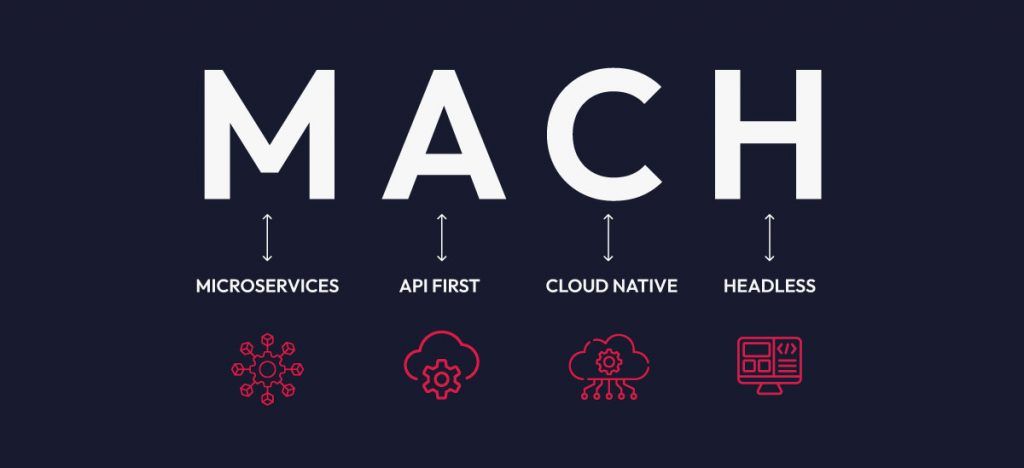
MACH architecture offers a framework for building adaptable digital solutions. It promotes a modular approach, using best-of-breed services and technologies to solve business challenges. MACH (Microservices, API-first, Cloud-native, and Headless) empowers organizations to create flexible, future-proof systems by enabling the composition of pluggable, scalable, and independently deployable components. This architecture is essential for businesses seeking to rapidly innovate and deliver exceptional user experiences in today’s dynamic digital landscape. Let’s look at some aspects of the MACH architecture:
Microservices:
Microservices within MACH architecture break down applications into independently deployable, small services. Each service focuses on a specific business capability and communicates using lightweight APIs. This approach fosters flexibility and rapid development, essential for today’s dynamic digital landscape.
API-first:
An API-first approach prioritizes APIs as the foundation for building applications and services. By developing APIs initially, organizations ensure all functionalities are accessible through standardized interfaces. This promotes integration, flexibility, and streamlined front-end development.
Cloud-native:
Cloud-native applications are designed to fully leverage cloud computing capabilities. By utilizing cloud infrastructure, these applications achieve scalability, resilience, and flexibility. Unlike traditional applications, they can adapt to changing demands and ensure high availability.
Headless:
Headless architecture decouples a web application’s front-end/mobile app from its back-end. This enables independent development and management of the user interface and data storage layers. APIs deliver content, products, or services to any device, while content creators focus on content management without UI constraints.
Contents
MACH architecture is a cornerstone of modern software development. Its emphasis on agility, scalability, and flexibility aligns perfectly with today’s fast-paced digital landscape. By shifting from monolithic systems to composable architectures, MACH empowers businesses to innovate rapidly and deliver exceptional customer experiences.
By combining agility, adaptability, and economic efficiency, MACH architecture empowers businesses to implement advanced digital solutions while effectively managing financial resources and operational costs.
These examples illustrate how MACH architecture can create flexible, scalable, and personalized digital experiences across various industries and use cases.
Monolithic architecture and MACH architecture represent two distinct approaches to creating digital experiences. Below is a comparison between them:
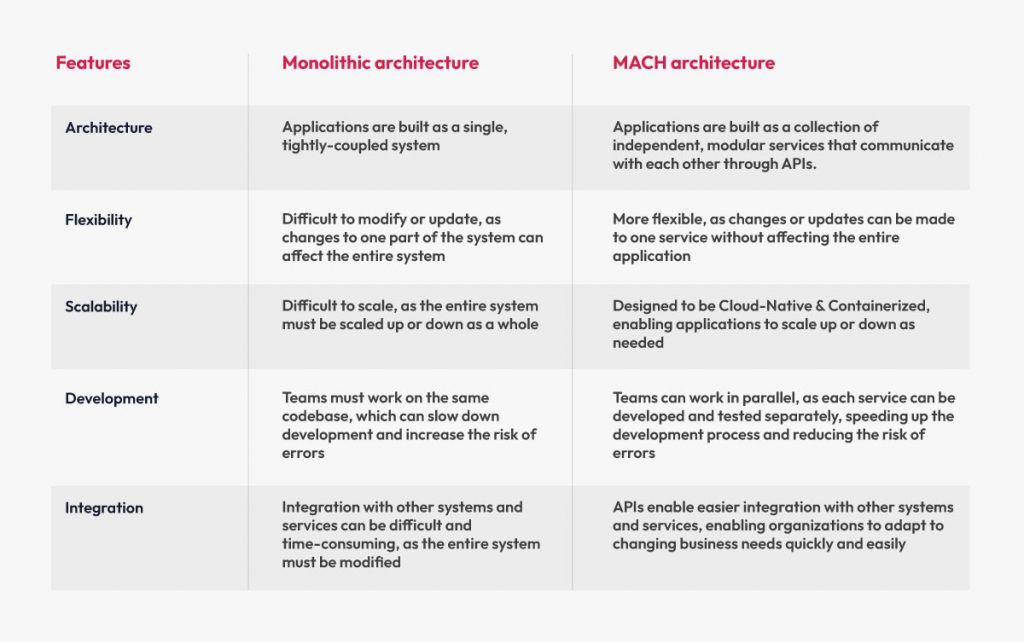
The choice between Monolithic and Microservices should be based on carefully considering the specific requirements and trade-offs of the project at hand.
Determining if MACH architecture suits your digital projects requires considering several factors:
In conclusion, MACH architecture is a transformative approach that empowers organizations to build adaptable, scalable, and customer-centric digital solutions. By embracing microservices, API-first principles, cloud-native technologies, and headless architecture, businesses can unlock new opportunities, accelerate innovation, and deliver exceptional experiences. While the journey to adopting MACH may present challenges, the long-term benefits in terms of agility, efficiency, and competitive advantage are undeniable. As the digital landscape continues to evolve, MACH architecture stands as a robust foundation for future-proof success.

By Prashantha Hegde
Prashantha Hegde is our Senior Principal Technical Architect with around 18 years of experience spearheading the design and development of IT solutions. A recognised leader, he applies high-impact technical solutions to meet the business objectives of enterprises in diverse domains, especially in financial services. His interests include Enterprise Architecture, full-stack development, DevOps, and more. Outside of work life, he has keen interests in Aviation and History.

RESOURCES
By Abhishek Hegde

By Ivan Pinto
Most conversations about AI delivery focus on what the delivery partner brings to the engagement. The methodology, the toolchain, the engineering practice, the governance standards. We have written elsewhere about what Robosoft brings, and about the standard we have built ARIA around.

By Srinidhi Rao
Most organizations evaluating AI delivery partners are asking the wrong question. They tend to ask which tools a firm uses, when the question that actually matters is what standard the firm is operating to.
A tool is a productivity bump. A standard is what shapes whether the work compounds or stays flat. It is, in our experience, much of why AI projects fail to move past the productivity bump. Firms producing genuinely different outcomes with AI today are doing so because the same operating rules run through every decision, every gate and every phase of the work.
Engineering
Human
Experiences
Let’s get in touch
We craft intuitive digital products that blend user-centric design with robust technology. From UX/UI to full-stack development, we help brands turn ideas into scalable solutions.