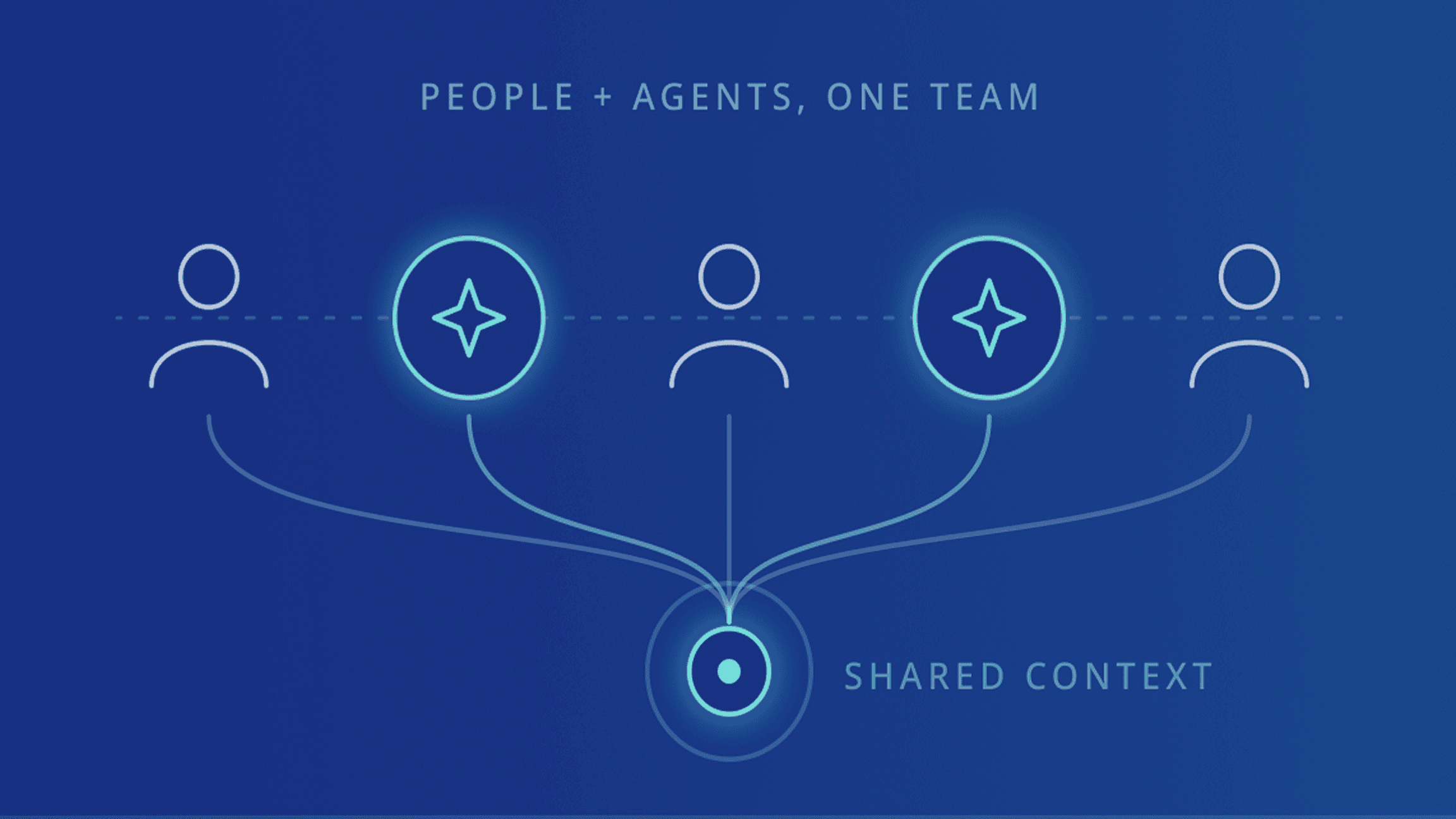
AI in travel is no longer experimental. It is already embedded across customer experience, operations, and decision-making. The challenge now isn't getting companies to adopt it. It's scaling the impact across systems that were never built to talk to each other.
Travel companies run on fragmented platforms: booking engines, operational systems, and customer experience layers that function independently of one another. Travelers don't experience any of that separation. They expect continuity across the journey.
That disconnect is exactly where AI creates the most value in travel. It enables real-time decisions across the entire journey, shifting the focus from isolated features toward systems that keep optimizing outcomes as conditions change.
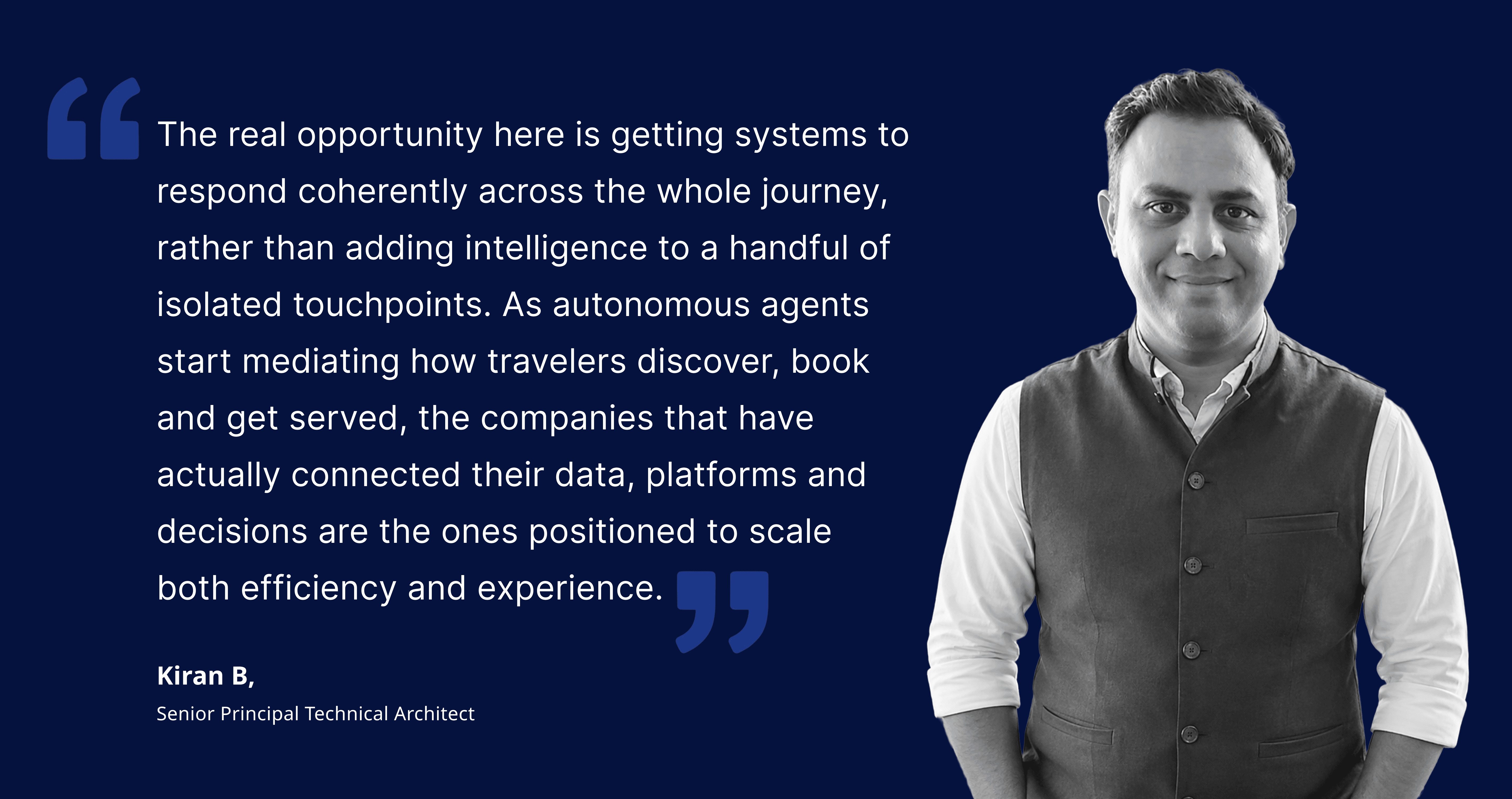
AI in Travel Booking: Enterprise Use Cases Driving Revenue
Booking used to be a transactional interface. It's becoming a continuous revenue system instead, part of the broader shift toward travel retailing, where airlines and providers manage dynamic offers rather than static fares. AI enables continuous pricing, personalized bundles, and real-time offer optimization, but all of it depends on pricing engines, inventory systems, and experience layers operating as one unified system rather than three separate ones bolted together.
In our work with Akasa Air, that meant designing a booking platform that goes well beyond search and selection. We structured journeys around traveler personas, integrated fare intelligence and built in contextual add-ons, which let the platform capture behavioral signals across the entire booking flow. That's the foundation that lets pricing, recommendations and conversion keep improving continuously, rather than sitting off to the side as a separate layer bolted onto the booking flow.
AI in Travel Operations: Acting on disruption, not just predicting it
In travel, how you handle a disruption usually matters more than the disruption itself. Delays, cancellations and operational constraints are constant. What AI changes is whether an organization responds proactively or scrambles after the fact.
Key AI use cases in travel operations include:
- Predicting disruptions before they escalate
- Optimizing fleet, crew, and infrastructure allocation
- Automating passenger re-accommodation
- Improving visibility across interconnected systems
What matters is not prediction accuracy alone, but the ability to act on predictions in real time.
That kind of speed needs a tightly integrated ecosystem underneath it. In our work on Al Maha Island during the FIFA World Cup, we built a connected digital ecosystem spanning customer applications, merchant systems and operational dashboards, unifying data flow across booking, payments and access points. Architectures like that are essential for AI in travel operations, where disruption management and real-time decisioning rely on consistent, cross-system visibility.
AI Customer Experience in Travel: From Support to Journey Orchestration
Customer experience in travel used to come down to individual interactions. Now it comes down to how consistently information, decisions, and context carry across the whole journey, and AI's role is connecting customer experience directly to operational and behavioral data rather than treating them as separate concerns.
In our work with Big Bus Tours, improving the experience took more than interface polish. Real-time location intelligence, in-journey interactions, and contextual upselling let the platform respond to traveler behavior as it actually happened, turning support into something closer to a continuous engagement layer.
Something similar happened with Brightline, where we integrated mobile apps, web, kiosks and physical infrastructure into one system, so real-time data could flow across booking, check-in, navigation and service. Personalization and operational responsiveness only become real once a platform like that exists underneath them. Without it, they're just features sitting on top of systems that don't talk to each other.
Where generative and agentic AI are heading next
Generative AI is already expanding how travel companies talk to customers and manage internal work: AI-generated itineraries and recommendations, faster summarization of feedback and operational data. Agentic AI goes a step further, where the system moves from assisting someone to actually executing on their behalf, automatically rebooking a disrupted journey, coordinating across multiple service providers, surfacing real-time decision support for employees handling a problem.
A real shift is already underway in how people plan trips. Early adopters are handing the entire process to AI agents: itinerary creation, hotel selection, flight booking, with more of these ending in an agent-completed transaction rather than a human clicking through each step. As that becomes a normal workflow rather than an edge case, it creates a structural problem for travel brands that nobody's fully solved yet.
Being discoverable to an AI agent is a different problem than ranking in search results. Agents don't browse. They query, evaluate, and act on structured, reliable data. Brands whose information is accurate and consistently accessible across systems are the ones that get recommended, and transacted on behalf of the traveler, by the agent doing the deciding. It's a close cousin of the problem travel companies faced two decades ago when search engines rewrote how distribution worked, except this time agent-readiness is an infrastructure requirement already here, not something to plan for later.
The platforms we've built for organizations like Brightline and Akasa Air, with unified data models, real-time service layers, and consistent information architecture across channels, are exactly the kind of foundation this requires. A structured, connected platform serves travelers well today and, just as importantly, gives an AI agent something it can actually act on tomorrow.
As these systems take on more of the decision-making, governance, data security, and model reliability stop being nice-to-haves. AI has to operate inside defined controls while staying accurate and trustworthy in situations where getting it wrong actually costs something.
Why so many of these initiatives stall anyway
Despite real momentum, plenty of AI initiatives in travel never scale past the pilot. The usual culprits: data fragmented across booking, operations, and loyalty systems, legacy infrastructure that can't support real-time responsiveness, weak integration between digital platforms and physical environments and AI bolted on as an overlay instead of built into the actual workflow.
Often the data already exists. What's missing is the ability to put it to work in real time, across systems that weren't designed to share it. Infrastructure, far more often than the algorithm itself, is the real barrier. A model sitting on top of a system that can't support real-time exchange and orchestration isn't going to deliver much of anything.
Realizing any of this in practice means rethinking how the underlying platforms get built in the first place. Across our work in travel and transportation, that's meant designing platforms where booking, operations and customer interaction share a common data model and run on real-time services, the foundation that lets AI scale past an isolated pilot into something the whole enterprise runs on.
The real impact of AI in travel comes from connecting decisions across booking, operations, and customer experience, not from automation or personalization treated as standalone wins. Scaling that takes real collaboration across technology partners, platforms, and internal teams, not just a better model.
At Robosoft, we work with travel and transportation organizations to design and engineer connected digital platforms where experience, data, and operations function as one system rather than three. From AI-driven booking journeys to integrated ecosystems spanning physical and digital environments, the goal is the same throughout: outcomes that are actually measurable, not just a pilot that looked promising in a demo.
If you're not sure where your current platforms are limiting what AI can actually do across booking, operations and customer experience, that's a conversation worth having with our team.