K+
%
BACKGROUND
First Bus is one of the UK's largest public transport operators, serving over 1.2 million passengers across its mobile platform. When the business decided to move to a new ticketing provider and redevelop its customer-facing apps, the brief was unambiguous: do all of it without a single moment of disruption to the passengers who depend on the service every day.
That is a harder constraint than it sounds. These are not discretionary users who can be asked to reinstall an app or wait for a patch. They are commuters with live tickets, active accounts, and no tolerance for a platform that fails them at the bus stop. Any migration that caused even brief disruption to live transactions would be a public failure on a public service.
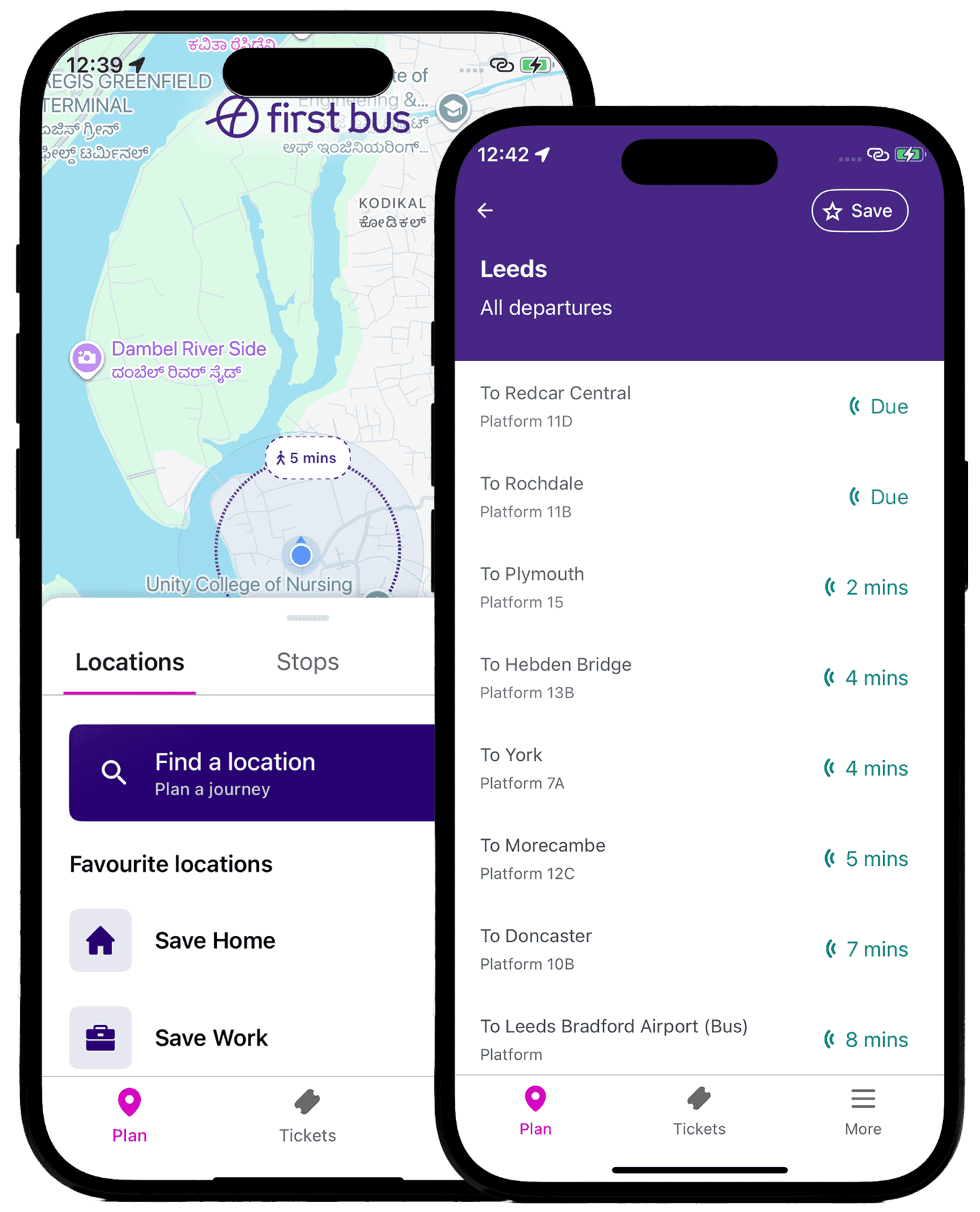
Robosoft was brought in to deliver the full program: a rebuild of the iOS and Android apps on modern architecture, a structured multi-phase migration to the Masabi ticketing platform, and a new mobile backend integrating with a full ecosystem of third-party tools. The measure of success was not feature delivery. It was whether 1.2 million users could be moved to a new platform without disruption.
THE CHALLENGES
Addressing the
critical gaps

The apps were already in active use. Any change to the iOS and Android codebase had to be managed so that users already on the platform experienced no degradation. There was no opportunity to take the service offline, run a parallel platform indefinitely or ask passengers to switch manually.

Moving active users from the legacy ticketing platform to Masabi required backward compatibility at every phase. Live tickets had to remain valid throughout. Account data had to carry across cleanly. At no point could a passenger find themselves unable to board because a migration had broken their ticket.

The rebuilt apps needed to integrate with a new mobile backend, the Masabi ticketing platform, Transport API, Google Maps API, and a suite of tools covering CRM, analytics, privacy compliance and application security. Every dependency had to be coordinated without a breaking change reaching production.
THE CHALLENGES
Addressing the
critical gaps
The apps were already in active use. Any change to the iOS and Android codebase had to be managed so that users already on the platform experienced no degradation. There was no opportunity to take the service offline, run a parallel platform indefinitely or ask passengers to switch manually.
Moving active users from the legacy ticketing platform to Masabi required backward compatibility at every phase. Live tickets had to remain valid throughout. Account data had to carry across cleanly. At no point could a passenger find themselves unable to board because a migration had broken their ticket.
The rebuilt apps needed to integrate with a new mobile backend, the Masabi ticketing platform, Transport API, Google Maps API, and a suite of tools covering CRM, analytics, privacy compliance and application security. Every dependency had to be coordinated without a breaking change reaching production.
THE ROBOSOFT SOLUTION

We rebuilt the iOS and Android apps on a modular, scalable codebase designed for long-term maintainability and extensibility. The architecture supports both vertical and horizontal growth as First Bus's digital requirements develop, without requiring the kind of structural rework that made the previous platform difficult to evolve.

The migration to Masabi was executed in multiple phases, with backward compatibility maintained at each stage. This was the most operationally complex part of the engagement. Every phase had to be designed so that a user with an active ticket or a live transaction was never affected, regardless of where they were in the migration sequence. The platform reached 98% of total ticket transaction volume migrated to Masabi by week 13, with no service interruption at any point.

The new mobile backend was built to connect the rebuilt apps with the full ecosystem of tools First Bus relies on: Masabi for ticketing, Salesforce for CRM, NewRelic and GA4 for performance monitoring and analytics, AppsFlyer for attribution, Alchemer for user research, and OneTrust for privacy and compliance. Each integration was built and tested to ensure no single dependency could introduce instability into the live platform.
THE ROBOSOFT SOLUTION
We rebuilt the iOS and Android apps on a modular, scalable codebase designed for long-term maintainability and extensibility. The architecture supports both vertical and horizontal growth as First Bus's digital requirements develop, without requiring the kind of structural rework that made the previous platform difficult to evolve.
The migration to Masabi was executed in multiple phases, with backward compatibility maintained at each stage. This was the most operationally complex part of the engagement. Every phase had to be designed so that a user with an active ticket or a live transaction was never affected, regardless of where they were in the migration sequence. The platform reached 98% of total ticket transaction volume migrated to Masabi by week 13, with no service interruption at any point.
The new mobile backend was built to connect the rebuilt apps with the full ecosystem of tools First Bus relies on: Masabi for ticketing, Salesforce for CRM, NewRelic and GA4 for performance monitoring and analytics, AppsFlyer for attribution, Alchemer for user research, and OneTrust for privacy and compliance. Each integration was built and tested to ensure no single dependency could introduce instability into the live platform.

Clear outcomes
that drive

428K+ users were moved from the legacy platform to Masabi without a single moment of service interruption. Active tickets remained valid throughout. Account data carried across cleanly at every phase. For a public transport operator, this was not simply a technical metric. It was the baseline requirement, and it was met without exception.

The rebuilt platform reached 98% of total ticket transaction volume migrated to Masabi within 13 weeks of go-live. That pace, at that scale, with no service interruption, reflects both the quality of the migration architecture and the rigour of the testing approach that underpinned it.

99.62% crash-free users. since go-live, across the full active user base

509K accounts have been created via the new platform since go-live on 1 April 2026. Android monthly active users grew 153% between April and May 2026.
TESTIMONIALS

Our clients' words reflect the trust and impact we strive for in every partnership.


OWEN HUGHES
Director of Digital & Retail
Craft scalable digital platforms that maximize business results