



Blog
Media & Entertainment
8 Oct 2026•6 min read
The Broadcast Is Not the Test. It Is the Result of the Test.
By Abhishek Hegde

Agentic Integrated Development Environments (IDEs) are transforming software development in 2025 by embedding AI-powered assistance directly into everyday coding workflows. These intelligent tools streamline development cycles, simplify debugging, enhance deployment processes, and significantly boost developer productivity.
This shift isn’t just about keeping up with the latest tech trends; it’s a pragmatic response to the continuous demand for speed, efficiency, and innovation. Let’s explore what’s ahead and why delivery leaders must lean into this change.
AI assisted software development refers to the use of artificial intelligence tools and models to support developers throughout the development lifecycle. These systems don’t just autocomplete lines of code, but they understand context, suggest improvements, and even generate blocks of code based on intent.
These AI models operate quietly in the background, scanning the codebase, understanding developer behavior, and offering intelligent recommendations for syntax, structure, refactoring, or even unit test creation. The goal isn’t to replace the developer, but to reduce friction and accelerate high-quality output.
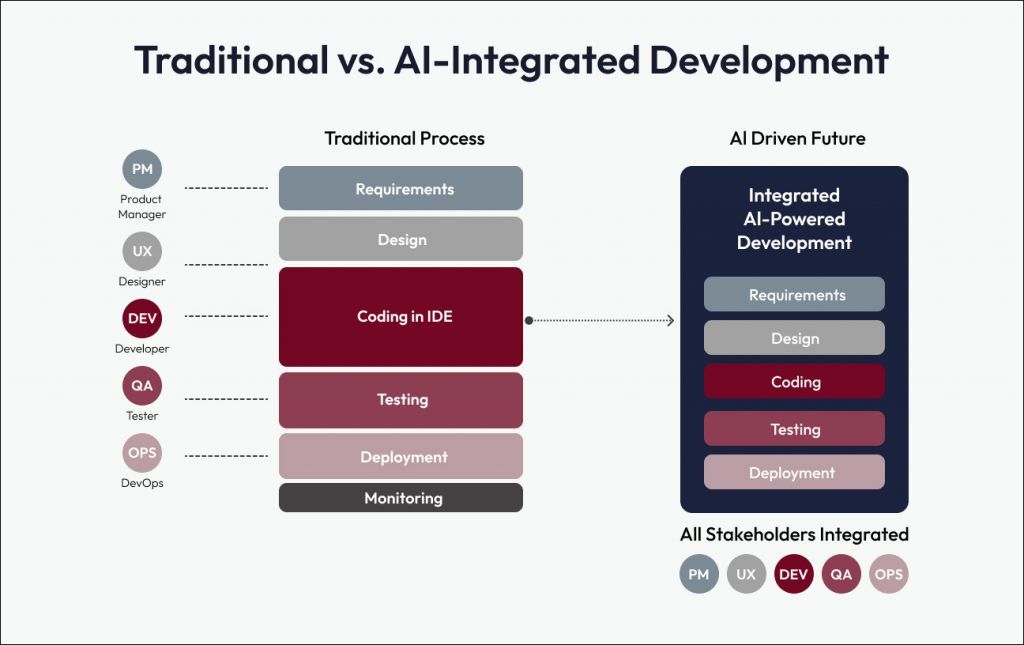
AI assistants such as GitHub Copilot, Amazon CodeWhisperer, and Replit Ghostwriter now play an integral role in software development workflows. These models can generate boilerplate, refactor code, and even write complete functions by interpreting inline comments and contextual cues. Developers are also beginning to use natural language prompts to describe their intent. This allows the IDE to generate or modify code in real time, much like working alongside a smart colleague.
This shift redefines the IDE as an intelligent partner in the development process – understanding context, anticipating needs, and accelerating delivery. Let’s explore how this transformation is reshaping the future of software delivery and what it means for teams ready to embrace AI-assisted development at scale.
The development workflows are becoming increasingly autonomous with agentic AI. These agents can:
Multi-agent frameworks (like AutoGPT or Devin) will execute tasks across the SDLC. The impact is significant: developers will guide these agents with prompts, monitor results, and focus more on orchestration than implementation.
Here’s how these agents are improving developer workflows:
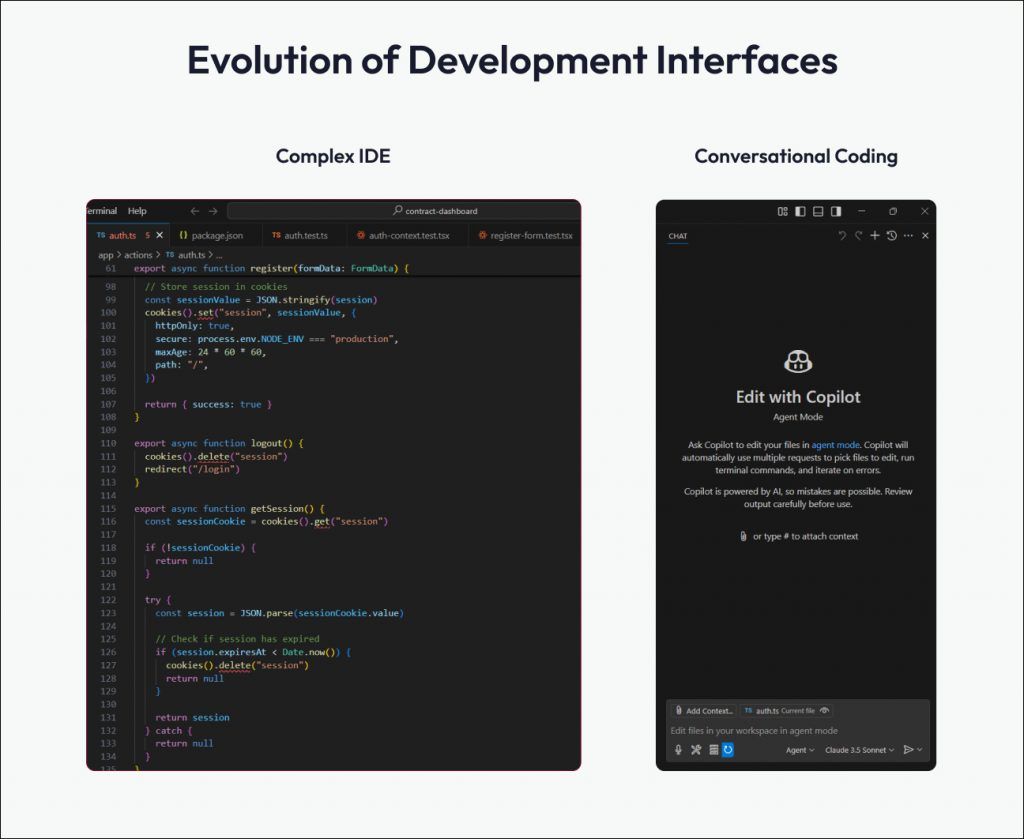
Image: Right side shows agent mode window where developers can delegate code editing, debugging, and command execution.
As AI assisted software development matures, the underlying architecture must evolve to support its speed and modularity. The future development will shift to composing solutions from modular services (micro frontends, microservices, reusable SDKs). Rather than building end-to-end monolithic applications, development is moving toward API integration, orchestration, and service mesh.
Also, read how MACH architecture enables agile and scalable digital solutions.
As platforms become more composable and modular, low-code, no-code development is gaining serious traction. Business users and domain experts can now prototype applications quickly using platforms like OutSystems or Mendix.
The role of professional developers is evolving. Pro developers are increasingly taking on responsibilities such as:
This shift positions experienced engineers as platform enablers and governance architects, ensuring low-code innovation doesn’t compromise software quality or technical integrity.
In an AI assisted development environment, agility and scalability are non-negotiable. That’s why cloud-native architectures and edge-optimized deployments are becoming the new default. Everything will be developed and deployed cloud-first. Real-time apps will leverage serverless functions, edge compute, and global CDNs. Developers will use Infrastructure as Code (IaC) tools and AI-optimized DevOps workflows.
Quality no longer waits for a dedicated QA phase. In an AI assisted software development lifecycle, testing shifts left. It is enabling real-time, autonomous testing by:
AI-driven testing is moving toward comprehensive scenario generation, including edge cases that human developers might miss. Future tools will likely generate entire test pyramids, from unit tests to end-to-end scenarios, while maintaining test data and managing test environments automatically.
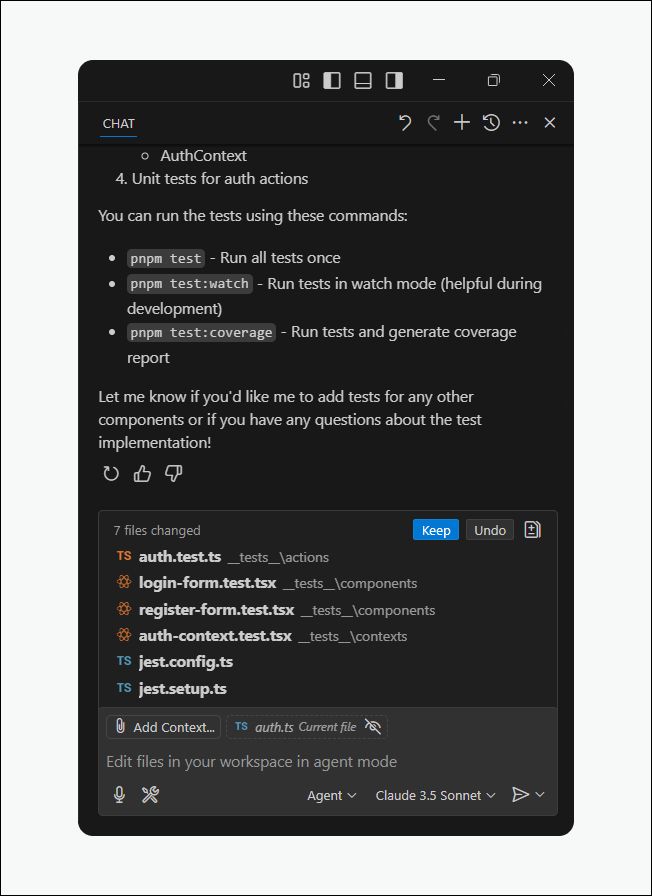
Image: Agent mode IDE supporting shift-left testing. Developers can write and run tests real-time while coding by simply delegating the task to the AI Agent.
As AI becomes more integral to coding and delivery workflows, engineering leaders turn to analytics-driven insights to understand and optimize team performance at scale. They will use tools like GitHub Insights, LinearB, or DX to assess productivity, quality, and velocity. What sets the next wave of engineering intelligence apart is AI-powered feedback loops. These systems interpret data in real time, offering suggestions to developers on how to write cleaner and faster code and effectively pair programming with telemetry.
The developer’s focus is shifting from writing low-level logic to defining intent and outcomes. With this new paradigm, teams will increasingly rely on DSLs, AI compilers, and event-driven abstractions to accelerate system development.
The future is clear: embrace this change, build the necessary skills, and step confidently into the role of AI orchestrator.
Developers will increasingly define and delegate tasks to intelligent agents, oversee outputs, and fine-tune results iteratively. Tomorrow’s most effective developers will approach AI not as competition, but as a force multiplier. Therefore, they should proactively expand their skill sets around prompt engineering, iterative design, and vibe coding.
The focus will shift from isolated functions to systems-level thinking, where developers act as designers of logic and stewards of architecture.
For CTOs and delivery leaders, this isn’t just a tooling upgrade; it’s a strategic transition. Success will depend on investing in AI upskilling programs and a supportive culture. The question isn’t whether this shift will happen, but how quickly you’re prepared to lead it.


By Ivan Pinto
Ivan is a Head of Delivery at Robosoft Technologies, leading application development, engineering, and QA teams. With expertise in web technologies (React, Angular, Node.js), mobile platforms (Android, iOS), and CTV & OTT streaming solutions (Samsung, LG, Roku, etc.), he specializes in delivering high-impact software services for global clients. A transformational technical leader and digital strategy expert, Ivan drives enterprise-wide digital and cloud transformations, aligning business objectives with technical execution. Committed to maximizing performance, quality, and ROI, he fosters team growth and continuous innovation to deliver scalable and future-ready technology solutions.

RESOURCES
By Abhishek Hegde

By Ivan Pinto
Most conversations about AI delivery focus on what the delivery partner brings to the engagement. The methodology, the toolchain, the engineering practice, the governance standards. We have written elsewhere about what Robosoft brings, and about the standard we have built ARIA around.

By Srinidhi Rao
Most organizations evaluating AI delivery partners are asking the wrong question. They tend to ask which tools a firm uses, when the question that actually matters is what standard the firm is operating to.
A tool is a productivity bump. A standard is what shapes whether the work compounds or stays flat. It is, in our experience, much of why AI projects fail to move past the productivity bump. Firms producing genuinely different outcomes with AI today are doing so because the same operating rules run through every decision, every gate and every phase of the work.
Engineering
Human
Experiences
Let’s get in touch
We craft intuitive digital products that blend user-centric design with robust technology. From UX/UI to full-stack development, we help brands turn ideas into scalable solutions.