



Blog
Media & Entertainment
15 Oct 2026•5 min read
Why Soccer Fans Keep Leaving Platforms They Actually Like
By Abhishek Hegde

AI has moved beyond efficiency gains. For leading fintechs and financial institutions, it now acts as a topline growth engine, powering smarter pricing, adaptive risk management, and personalized customer experiences. The question is no longer whether to adopt it, but how effectively it is embedded into the decisions that shape revenue, risk, and scale.
Fintech leaders are operating under mounting structural pressure. Margins are tightening, fraud patterns are becoming more sophisticated, regulatory scrutiny continues to intensify, and customer acquisition costs are rising.
For much of the last decade, competitive advantage was achieved through scale, with larger balance sheets, deeper data warehouses, and increasingly complex rule‑based systems. Today, those advantages are diminishing. Cloud infrastructure is broadly accessible, data is abundant, and open banking and embedded finance have lowered barriers across markets.
Across Robosoft’s work with fintechs and financial institutions, a clear shift is emerging: a competitive advantage now depends on how effectively data is converted into decisions and decisions into revenue at speed.
Artificial intelligence fundamentally reshapes this dynamic.
Competitive advantage in financial services has always been anchored in decision-making: pricing risk accurately, detecting fraud early, and responding to market signals faster than competitors. AI does not change this principle; it amplifies the advantage.
When AI systems are embedded directly into core financial workflows, every transaction, repayment, dispute, or fraud attempt becomes a feedback signal. Over time, this creates a compounding advantage that is difficult to replicate, even for competitors deploying similar models later.
At Robosoft, we see a durable advantage emerge only when AI operates as an intelligence layer beneath the enterprise, continuously learning from real decisions rather than existing as isolated models or analytical overlays.
Traditional credit and risk models are constrained by design. They rely on limited feature sets, infrequent refresh cycles, and static assumptions about customer behavior.
AI in fintech replaces this with continuous risk intelligence.
In practice, AI-driven underwriting models ingest a far broader set of signals: income volatility, employment trajectories, cash flow patterns, and behavioral indicators, and retrain continuously as conditions evolve. The outcome is not simply better risk control but the ability to profitably expand addressable markets while maintaining discipline on losses.
This represents a structural shift: risk management evolves from a defensive control function into a growth enabler.
While many fintechs initially adopt AI to improve efficiency or reduce operational friction, leading organizations embed AI directly into revenue‑critical decision points: pricing, conversion, personalization, and product expansion.
In practice, AI functions as a revenue orchestration layer. Sales platforms use it to prioritize leads, recommend next actions, and improve cross-sell effectiveness. Consumer fintechs personalize pricing, credit limits, and installment plans at scale, balancing growth with controlled risk exposure. Payment and BNPL platforms apply it across credit assessment, personalization, and customer service, improving transaction economics while reducing loss and cost.
Across these examples, the pattern is consistent: AI increases revenue per customer, per transaction, and per decision.
In the near term, much of AI adoption in fintech is focused on reducing decision latency. AI copilots are increasingly deployed across underwriting, compliance, customer service, and engineering functions.
These systems do not replace judgment; they compress time‑to‑decision by summarizing complexity, identifying anomalies, and accelerating regulated workflows. The result is scale without proportional increases in headcount or operational risk.At Robosoft, we see copilots as a transitional capability, standardizing execution and decision quality while preparing organizations for more autonomous systems.
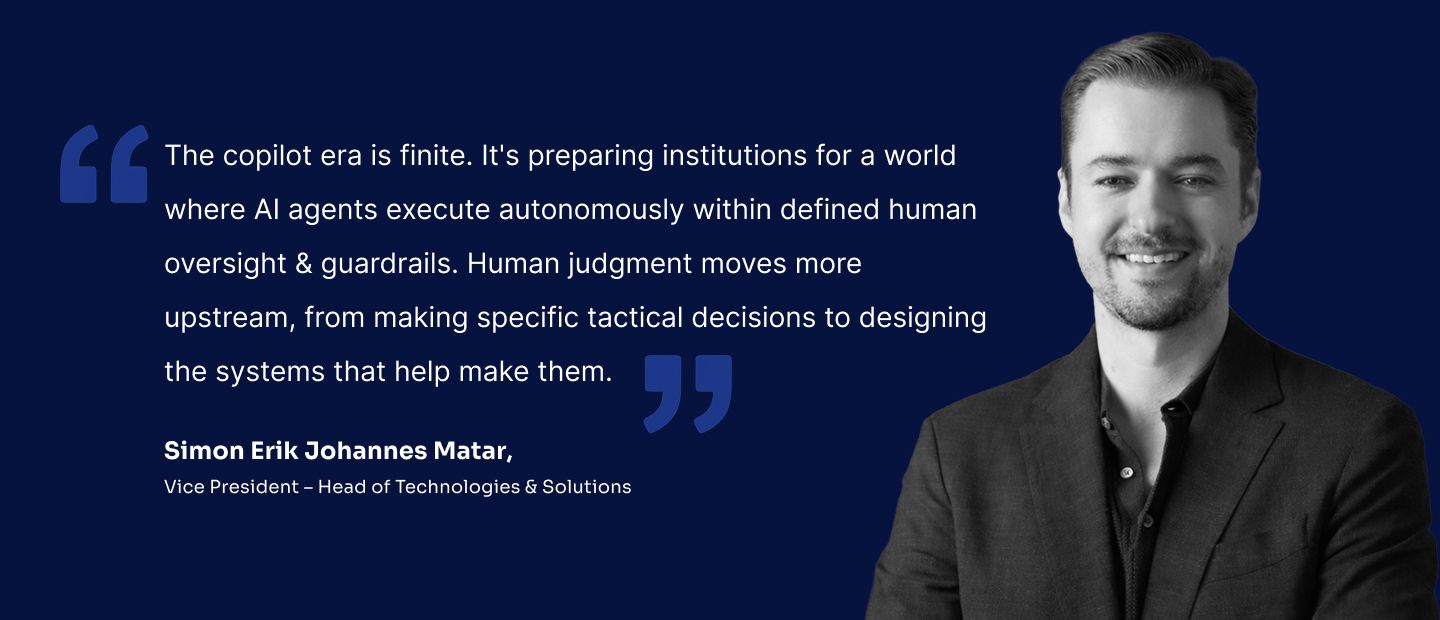
Over the longer term, AI in fintech will extend beyond decision support toward autonomous financial intelligence, operating within clearly defined governance and control frameworks.
Future systems will dynamically adjust credit limits, rebalance portfolios, and price risk in near real time, based on continuously evolving signals. Financial products themselves will become adaptive, reconfiguring based on customer behavior, market conditions, and risk indicators.
In this environment, competitive advantage will be defined by responsiveness and precision, not scale alone.
From Robosoft’s experience across fintech and financial services, three forces are accelerating AI adoption:
Together, these forces make AI not optional, but foundational.
One of the most persistent challenges fintech leaders face is not experimentation, but institutionalization.
From Robosoft’s experience scaling AI in regulated financial environments, initiatives stall when they remain disconnected from economic value, governance, or operating models. Organizations that scale successfully tend to:
AI becomes transformative only when it is treated as an operating capability, not a collection of tools.
AI is redefining how fintechs price risk, detect fraud, engage customers, and grow revenue in an environment of increasing complexity and competition.
The institutions establishing a durable advantage are not those deploying the largest number of models, but those embedding intelligence deeply, responsibly, and systematically into core financial decisions.
The opportunity for fintech leaders now lies in moving from AI adoption to AI‑driven execution at scale, where intelligence consistently translates into measurable business outcomes.
If you're exploring what AI-driven execution looks like in practice, we'd be glad to start that conversation.

By Chandan Chatterjee

RESOURCES
By Abhishek Hegde

By Abhishek Hegde

By Ivan Pinto
Most conversations about AI delivery focus on what the delivery partner brings to the engagement. The methodology, the toolchain, the engineering practice, the governance standards. We have written elsewhere about what Robosoft brings, and about the standard we have built ARIA around.
Engineering
Human
Experiences
Let’s get in touch
We craft intuitive digital products that blend user-centric design with robust technology. From UX/UI to full-stack development, we help brands turn ideas into scalable solutions.