



Blog
Travel & TransportationData & AI
5 Nov 2026•6 min read
AI in Travel: Enterprise Use Cases Across Booking, Operations and Customer Experience
By Janardhana T

In today’s fast-paced digital landscape, software development is experiencing a democratizing shift, expanding its reach beyond specialized programmers to include a broader spectrum of individuals. Market predictions underscore this transformative moment.
Estimates by Emergen Research suggest that by 2028, the no-code market will surge to an impressive $68.05 billion (about $210 per person in the US). On the other hand, as per Growth Market Reports, the global no-code platforms market (which stood at $12.13 billion in 2021) is projected to index $68.03 billion by 2030. This paradigm shift speeds up the software development process and unlocks a new era of digital innovation driven by a wider community than ever before.
If you have been anywhere near the buzzing world of software development, the term “no-code” might have piqued your interest. No-code models are sophisticated platforms designed to let users craft and launch applications without writing a single line of traditional code. It bridges those dreams of having a unique software solution and the formidable barrier of intricate programming knowledge.
Think of it like assembling a puzzle. Traditional coding is like crafting each piece of the puzzle from scratch. On the other hand, no code provides you with all the pieces; your role is to assemble them coherently to create the desired picture. This approach democratizes software development and empowers a vast population of non-developers to translate their visions into functioning digital solutions.
For instance, consider the ambitions of a restaurant owner dreaming of a unique loyalty program through an app. The conventional route would mean hiring a developer, explaining the vision, undergoing multiple iterations, and hoping the final product aligns with the original vision. With no-code platforms, this restaurant owner can enter the development world regardless of their tech savvy. They can choose and customize features, design layouts, and deploy their loyalty app, ensuring it aligns perfectly with their vision.
This paradigm shift speeds up the software development process and unlocks a new era of digital innovation. The constraints of technical prowess no longer shackle the digital dreams of many. In the evolving app development landscape, this philosophy – where creative vision takes the driver’s seat over technical limitations – is rapidly becoming the new code among developers and business professionals alike.
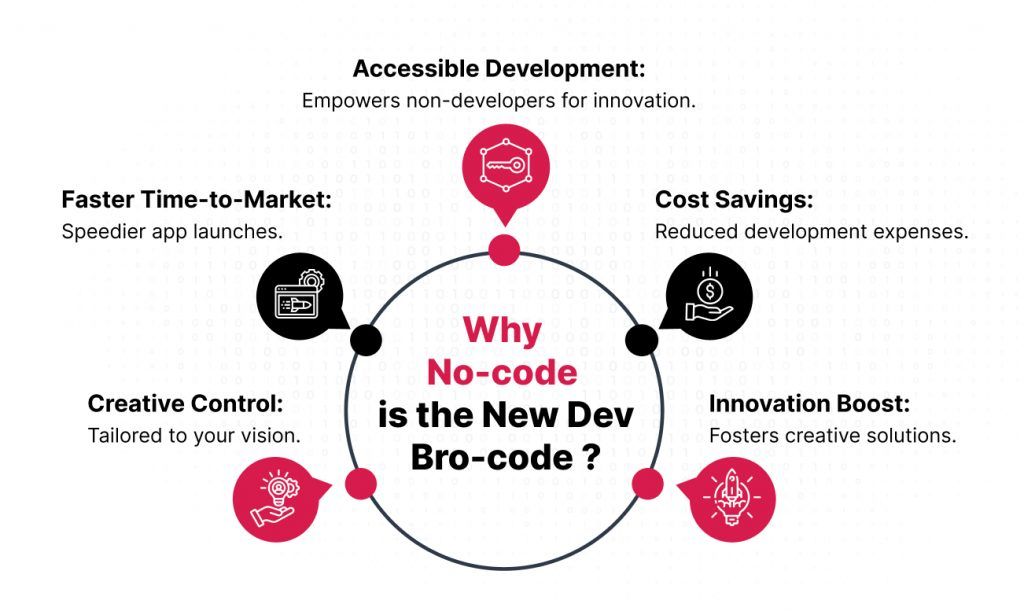
Some compelling reasons for the ascent of no-code models include:
But why the sudden infatuation with no-code platforms?
That is simple – It is about empowerment, collaboration, swift T2M, intelligent resource allocation, and cost savings.
While no-code development is undoubtedly a transformative force in the tech industry, it is not a one-size-fits-all solution to every problem. Much like any powerful instrument, it requires thoughtful and responsible usage, with an awareness of hazards that could present themselves.
Venturing into no-code is comparable to embarking on an excursion into uncharted territory: the experience can offer awe-inspiring vistas and invaluable rewards, but it is not without its complexities and risks that one must carefully manage.
First and foremost, let us address the temptation of quick development.
The accelerated pace enabled by no-code platforms can inadvertently lead to hastily rolling out applications, sometimes at the expense of vital quality assurance steps. To draw an analogy, it is like using a cake mix: the simplified process does not mean you can neglect to test if the cake is fully baked. This cautionary note, when translated into the software language, implies that you should still rigorously test the application to ensure it performs well across various devices, meets the users’ needs and expectations, and is devoid of glitches or bugs.
Then comes the challenge of decentralized app creation.
With more people enabled to create, there is a surge in applications popping up everywhere. Imagine a bustling city with buildings springing up without proper urban planning. This can result in apps that need more cohesion with a company’s broader digital infrastructure. This decentralization can also be a breeding ground for shadow IT (Information Technology), bypassing critical security protocols and governance structures and exposing businesses to security threats.
Integration is another factor that demands attention.
In today’s interconnected digital ecosystem, applications do not function in isolation. They are part of a vast network, interacting with various systems. If a no-code platform does not seamlessly integrate with, let us say, your existing CRM or ERP systems, it is like trying to fit a misfit. The result? Disjointed systems and potential inefficiencies.
It is also worth discussing the concept of technical debt.
No-code platforms, with their predefined functionalities, are fantastic for quick deployments. However, as businesses grow and requirements become more intricate, deeper customization might be needed, which could strain the capabilities of a no-code platform. Think of it as starting with a toy car for quick travel, but as you embark on longer journeys, you might need to upgrade to a more robust vehicle.
Finally, data breaches – a persistent concern in today’s digital age.
With the proliferation of applications created through no-code platforms, rigorous security checks are not just recommended; they are imperative, primarily when the application interacts with external stakeholders or involves sensitive data.
In short, while the no-code journey promises unfettered innovation and rapid development, it requires thoughtful navigation. The key lies in balancing the liberating power of no-code with a commitment to quality, security, and integration.
Dipping your toes into the no-code waters can feel both exhilarating and overwhelming. The plethora of platforms and their expansive possibilities is akin to a kid stepping into a colossal candy store for the first time. Where do you begin? And, most importantly, how do you ensure you get the most out of this transformative technology? Here’s a roadmap to help you navigate:
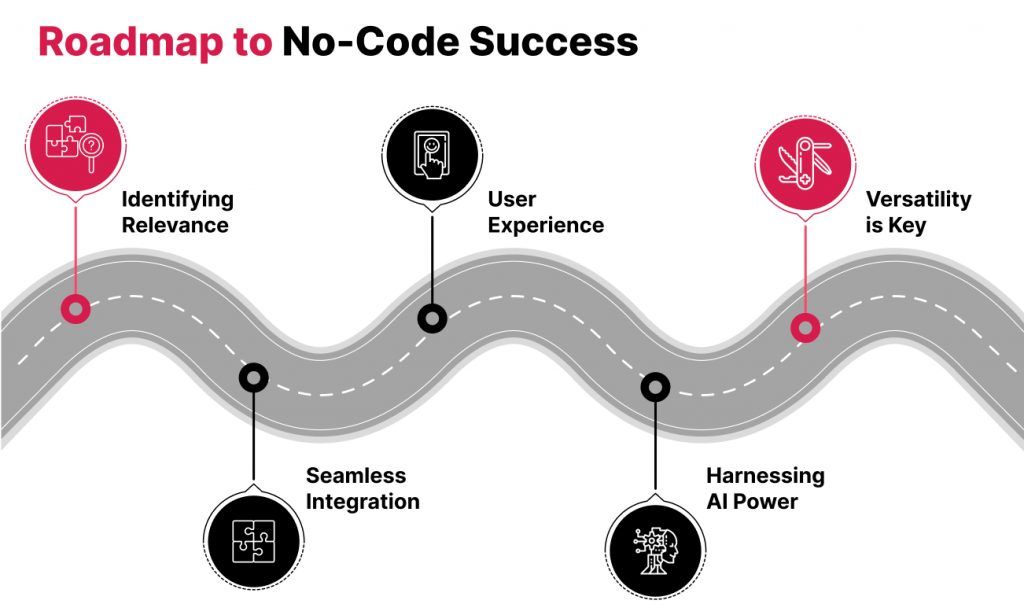
The market is awash with choices, each vying for your attention with unique selling points. From Zapier’s vast integration capabilities to Salesforce Lightning’s comprehensive development suite, the options are plentiful. The trick lies in discerning which platform meshes best with your unique requirements.
Remember, opting for the no-code is not mindlessly chasing the latest trend. It’s about strategically leveraging a powerful toolset to elevate your business, innovate faster, and deliver unparalleled value. With the right platform and a clear vision, the digital world becomes your oyster.
Some of the Use- cases of Platforms implementing No-code Technology
In this vibrant digital era, no-code platforms are not just tools but transformative powerhouses. They democratize innovation, breaking down the barriers that once limited the creation of digital solutions to a select few. No longer are businesses and individuals bound by their technical know-how. Everyone can craft their digital destiny with no code, from the local baker dreaming of a customized online store to the large corporation seeking streamlined operations. And while the appeal of no-code platforms is undeniably vast, it’s not just about having access to these tools but mastering them.
Read more: Navigating scalable website updates with agility amid constant change and complexity
Enter Robosoft- Our expertise goes beyond merely understanding the no-code movement. We champion and mold it to fit your unique needs and ensure you reap its maximum potential.
Partnering with Robosoft means unlocking doors to rapid innovation, cost efficiencies, and a tailor-made digital trajectory. Our team, seasoned in the art and science of no-code platforms, can guide, mentor, and work alongside you, ensuring that every step in this arena is strategic, sound, and successful.
If you envision a future where your business operates with agility, where digital solutions adapt and evolve in sync with your ideas, and where the digital landscape is navigable and accessible, let’s have a conversation. Together, we can explore various approaches to co-create the future, ensuring to meet your specific needs while considering the benefits of low-code and no-code platforms.

By Prashantha Hegde
Prashantha Hegde is our Senior Principal Technical Architect with around 18 years of experience spearheading the design and development of IT solutions. A recognised leader, he applies high-impact technical solutions to meet the business objectives of enterprises in diverse domains, especially in financial services. His interests include Enterprise Architecture, full-stack development, DevOps, and more. Outside of work life, he has keen interests in Aviation and History.

RESOURCES
AI in Travel: Enterprise Use Cases Across Booking, Operations and Customer Experience
By Janardhana T
More Models, Fewer Decisions: How to Scale AI Adoption Without Scaling the Bill
By Simon Matar
We are seeing the same pattern with our clients. Once AI adoption reaches a certain point, costs rise faster than the annual budget can absorb. So what drives these costs, and how do you keep adoption going without the budget...

The Software-Defined Vehicle Reset: How OEMs Must Rebuild for the Next Decade
By KaliCharan Manchikanti
Engineering
Human
Experiences
Let’s get in touch
We craft intuitive digital products that blend user-centric design with robust technology. From UX/UI to full-stack development, we help brands turn ideas into scalable solutions.