



Blog
Media & Entertainment
8 Oct 2026•6 min read
The Broadcast Is Not the Test. It Is the Result of the Test.
By Abhishek Hegde

Creating a product vision is not just the first step towards embarking on the journey of successful product development, it is the most critical one.
“Be stubborn on vision, but flexible on details” – Jeff Bezos
Enterprises across the globe have various tools and methodologies for arriving at the product vision. PR FAQs (Press Release FAQs) is one such tool. A PR FAQs document is a press release including critical FAQs, that is written for a product that will be released in the future. It is usually written by the product teams for a hypothetical launch of a product, considering that it is already released.
The concept of PR FAQs first introduced by Amazon is now used by product teams across organizations.
At Robosoft, we use Design Thinking principles to understand users’ pain points and needs and then create a product vision that not just solves the real challenges of customers but is in line with our clients’ business goals as well. PR FAQs is a tool that can help product teams present these learnings in a simple format for all the stakeholders across the organization.
Creating PR FAQs is an approach where the product teams work backwards – i.e. they visualize how their end product will look, what consumer challenges it will solve, and how it will solve it? All these are then addressed in the PR FAQs document while keeping customer needs at the center.
The concept of Amazon Go, the chain of automated convenience stores, was a direct result of the “working backwards” approach, which begins with the creation of a PR FAQs document (a press release, frequently-asked questions document, and visual mock-ups). In this case, it all began with identifying the problem: customers hate standing in lines, using the PR FAQs tool.
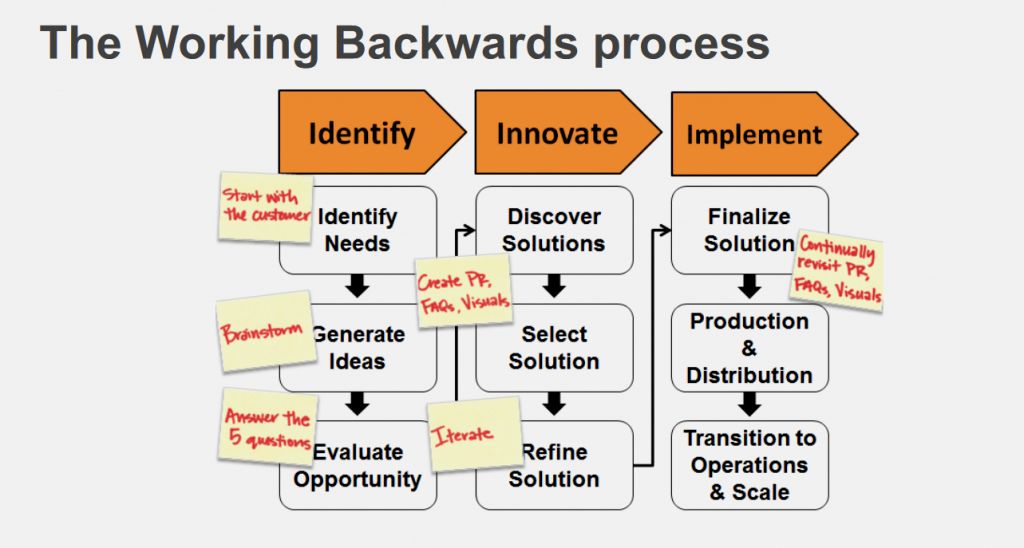
Image source
Typically, product managers use a product brief to describe their product. This serves as a starting point for the company’s product development and a brief introduction. A PR FAQs document serves as a more futuristic and customer-oriented product brief.
Product teams create a PR FAQs document imagining that the product is already developed and released. They have already envisioned the final product in their minds while writing a PR FAQs document.
Usually, a PR FAQs document will answer the following questions for all stakeholders – design, development, sales & marketing teams, etc.
The format for a typical product brief is as follows:
Now let us take a look at a PR FAQs template:
Some samples of how a hypothetical press release looks like can be found here and here.
A PR FAQs is a commitment to deliver
The PR FAQs is much more than a product brief tool. The press release opens with a location and date of publication; this helps the product team to focus on an idea and commit to meeting their tentative delivery date. Along the way, details and dates might change, but it keeps teams accountable to ultimately deliver on their vision. A PR FAQs is more than a document – it’s a commitment to deliver
Gives perspective to all the product stakeholders
A PR FAQs is written keeping customers at the center and is aimed to give all the stakeholders a brief about the product idea. But, if the PR FAQs document is not clear or exciting enough, the product idea might need to be refined further. A PR FAQs document can help identify shortfalls in the product idea at a very initial stage and can help identify issues like – cramming too many features, or not being able to address the real user pain-points and more. If stakeholders are asking questions that can’t be answered in the FAQs, then the product idea needs to be refined further before starting to build it.
As McAllister, former General Manager at Amazon explains, “Iterating on a press release is a lot less expensive than iterating on the product itself (and quicker!).”
Furthermore, the FAQ component of the document can be extremely effective in capturing the assumptions and perspectives of different stakeholders in a consistent format that everyone involved can understand.
Helps in defining product vision and roadmap
A PR FAQs document can give focus and clarity on the challenges the product will solve for customers. It helps articulate what the client experience needs to be, defines specific requirements that are needed for the final product, highlights the most important features, and hence helps create a product vision and a roadmap.
Motivates the design and development teams to create an exciting product
A PR FAQs document can help product teams test their product idea and gain buy-ins from clients and internal teams on particular features or the product overall. A press release should be engaging and exciting and explaining what your product does. If the press release is not exciting, chances are the product isn’t going to be engaging either.
Getting the stakeholders excited about a “press release” sets the stage for motivated teams when the actual product is built.
A PR FAQ document is useful not just for the product teams but multiple stakeholders in the product design and development journey. Here’s how:
Engineering teams: PR FAQs document can be used to start scoping out the technical aspects of the product. The development team can start by looking at what the product is, how it will help solve any issues, and how much time it will take.
While a product document might be independent of the technical solution, it can help to include some details that will give reviewers an idea of the scale of potential solutions.
The PR FAQs document can be beneficial for the engineering team to immediately start thinking about solutions to the product: what are the code libraries, databases, caching solutions, etc.?
Design teams: the PR FAQs document can help design teams to start thinking about design concepts. It is not necessary to create a text-focused PR FAQs document. Adding a basic wireframe or an MVP concept can help the design teams to further visualize the design elements.
Sales teams: the PR FAQs document can help sales teams to start looking into the marketing of the product, what the market would be, who would buy it, and how profitable it would be for the company.
Marketing teams: the PR FAQs document can help marketing teams craft a key message or benefit that would be attractive to the end customer.
Other Stakeholders: the PR FAQs document can be used to see what resources need to be assigned to this product and how much time it would take to accomplish its implementation.
In situations where the product brief or PR FAQs document is cumbersome and difficult, it can be an indication that the product itself might not be worth the effort for implementation. Although, this might not hold true for all products and vary according to the product idea. Each company must find its own way of approaching the implementation of the product and see what works for them.
The most appropriate way to approach the process would be to begin with the basic given format described above and customize the product along the way. This allows for flexibility in the flow of the writing as well as allows room for things such as visuals and graphs that can be beneficial to decision-makers and stakeholders.
Download the above template for creating a PR FAQs document for the next product idea of your enterprise.

By Maleeha Naipaul

RESOURCES
By Abhishek Hegde

By Ivan Pinto
Most conversations about AI delivery focus on what the delivery partner brings to the engagement. The methodology, the toolchain, the engineering practice, the governance standards. We have written elsewhere about what Robosoft brings, and about the standard we have built ARIA around.

By Srinidhi Rao
Most organizations evaluating AI delivery partners are asking the wrong question. They tend to ask which tools a firm uses, when the question that actually matters is what standard the firm is operating to.
A tool is a productivity bump. A standard is what shapes whether the work compounds or stays flat. It is, in our experience, much of why AI projects fail to move past the productivity bump. Firms producing genuinely different outcomes with AI today are doing so because the same operating rules run through every decision, every gate and every phase of the work.
Engineering
Human
Experiences
Let’s get in touch
We craft intuitive digital products that blend user-centric design with robust technology. From UX/UI to full-stack development, we help brands turn ideas into scalable solutions.