The question most enterprises are asking has changed. It is no longer what we can build. It is how quickly we can learn what is worth building. That shift is rewriting the rules of digital product development.
Today's digital experiences are expected to be personalized, intuitive, AI-enabled and continuously adaptive. Yet many enterprises are still operating with long discovery cycles, distributed decision making and high-cost experimentation models. The result is a widening gap between what customers expect and what organizations can realistically deliver at speed.
In this environment, the ability to rapidly test, validate and evolve ideas is worth more than the ability to build at scale. And that is exactly where rapid prototyping is becoming a genuine strategic capability.
It is worth being precise about what that means. Rapid prototyping is not a UX exercise or a design deliverable. It is a business acceleration tool, one that moves enterprises from assumptions to validated decisions faster, reduces transformation risk, aligns stakeholders earlier and identifies what truly creates value before significant investment is committed.
Why is rapid prototyping accelerating now?
AI is reshaping both the economics and the velocity of experimentation. What once took months of design cycles, engineering coordination and infrastructure planning can now be explored in days. AI-assisted workflows, generative interfaces, low-code foundations, synthetic data and intelligent copilots have fundamentally changed the speed at which ideas can be tested and refined. But perhaps more importantly, AI is changing who gets to participate in innovation, opening the process beyond engineering teams to business, design and product leadership.
The result is a new operating model for digital innovation: one built around continuous experimentation and shared intelligence rather than sequential handoffs and lengthy approval cycles.
Rapid prototyping is becoming a strategic business capability
Historically, prototypes were seen as a pre-development artifact, static wireframes or visual concepts used to get stakeholders on the same page. That is no longer an accurate description of what digital product prototyping can do.
Today, prototypes can simulate business workflows, AI-driven recommendations, onboarding journeys, intelligent dashboards and conversational assistants. This shifts the role of prototyping from visualizing screens to validating business outcomes, and that is a meaningful distinction.
For enterprises, the implications are significant. Rapid prototyping reduces investment risk by validating ideas before commitment. It shortens decision-making cycles by giving stakeholders something concrete to evaluate rather than abstract proposals to approve. It strengthens customer centricity by grounding development in real user behavior. And it creates clearer transformation roadmaps, particularly when validating AI opportunities early, before infrastructure and integration costs begin to accumulate.
This is why the most discerning enterprises are no longer simply looking for vendors who can build products. They are looking for partners who can help them frame the right opportunities, validate ideas fast, visualize future-state experiences and move from ambiguity to clarity with confidence.
The rise of the AI-native product pod
At Robosoft Technologies, we believe rapid prototyping is not just about speed. It is about orchestrating the right combination of business thinking, experience design and AI-enabled execution.
To deliver this, we have developed lean AI-native prototyping pods designed to take a concept from idea to experiential validation in days, not quarters. Each pod pairs three complementary roles:
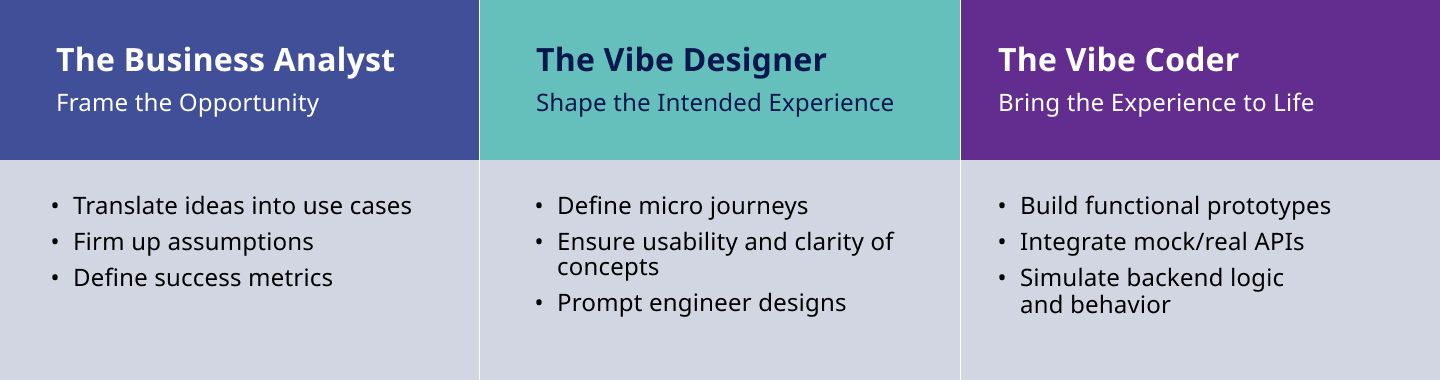
The Business Analyst translates ideas into use cases, firms up assumptions and defines the success metrics that matter. The Vibe Designer defines micro-journeys, ensures usability and conceptual clarity, and prompt-engineers the design layer. The Vibe Coder builds functional prototypes, integrates mock and real APIs, and simulates backend logic and behavior.
We deploy these pods both internally and with our customers, ensuring that possibilities are explored safely, assumptions are tested early and confidence is built before scaling investment.
In practice, an enterprise evaluating an AI-powered onboarding flow or an intelligent recommendation engine can move from concept to a functional, testable prototype in days. The goal is not to build something final. It is to answer the question that matters most before a full budget is committed: does this create the value we expect, and for whom?
That clarity is only possible when prototyping is run as a decision-making discipline, not a design exercise.
Product leadership will be defined by iteration velocity
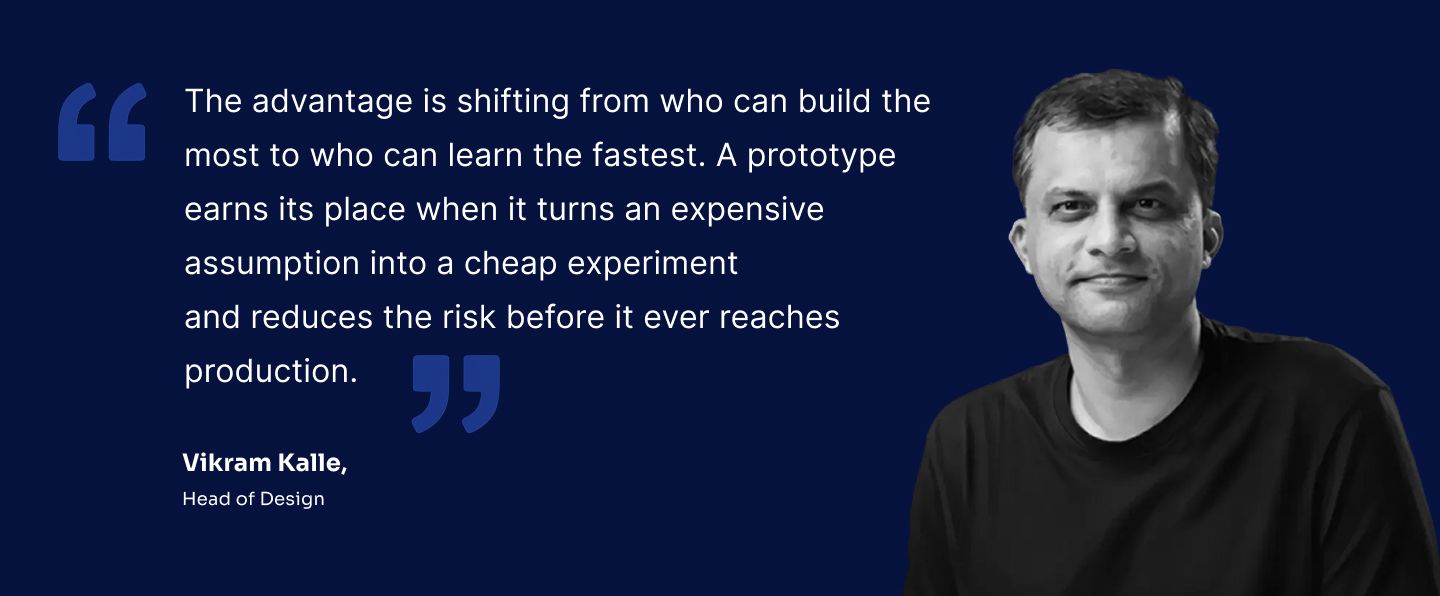
The next generation of digital leaders will not be defined by how much they ship. They will be defined by how fast they learn, adapt and validate.
Rapid AI prototyping, collaborative pods and product-centric thinking are becoming a foundational capability for that future. Organizations that treat learning velocity as a measurable outcome, not simply a byproduct of shipping, will build a structural advantage that compounds over time.
At Robosoft Technologies, we see rapid prototyping as the capability that bridges strategy and execution, turning ambiguity into clarity, assumptions into evidence and ideas into intelligent experiences. For leaders deciding where to place their next bets, the advantage belongs to those who learn fastest. If you are looking to turn product ambiguities into clarity faster, we'd be glad to start that conversation.
Get in touch: [email protected] · www.robosoftin.com