



Blog
Media & Entertainment
8 Oct 2026•6 min read
The Broadcast Is Not the Test. It Is the Result of the Test.
By Abhishek Hegde
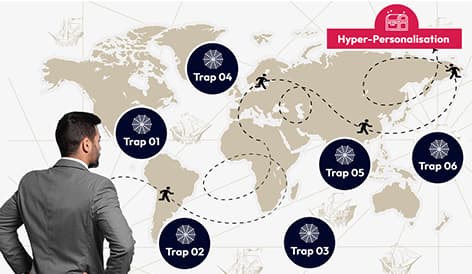
Every marketer dreams of crafting the perfect personalized experience—drawing the right amount and level of data, compiling it in the right format to create relevant communication, and delivering it at the right time. While hyper-personalization offers unprecedented opportunities, it also introduces risks that can alienate customers, erode trust, or damage reputations.
Let’s understand six common pitfalls or traps of hyper-personalization that an organization falls into quite often that can hamper their millions of investments in getting this right.
Shakespeare’s famous quote from Romeo and Juliet, “What’s in a name? That which we call a rose, by any other name would smell as sweet” is now commonly used to illustrate the idea that the name of things is not more important than the context or deed. Today’s consumers ask the same, particularly when name-based personalization lacks depth. Including a name may capture initial attention, but if that’s the extent of personalization, it quickly loses its impact. Worse, mistakes—such as using the full name or addressing someone by their middle name inappropriately—can be alienating or offensive.
An example would be a simple mail merger that just inserts a name into a generic email – it feels impersonal and outdated. Customers now recognize these automation tricks and expect more meaningful engagement.
Information overload is a significant risk in personalization. Customers, especially Gen Z, are quick to dismiss irrelevant or redundant messages with a “So what?” mindset. Customers today are willing to share personal information if they see brands using it effectively to elevate personal experiences. If your communications don’t simplify or enhance their lives, they risk being ignored—or worse, annoying your audience.
E.g. OTTs with poor recommendation engines sometimes suggest similar content repeatedly, leading users to feel that their preferences aren’t genuinely understood.
While segmenting audiences into groups may seem obvious and efficient, it risks oversimplifying individual needs. Customers increasingly see themselves as unique and expect brands to recognize their distinct situations. Herd messaging—treating everyone within a segment the same—can backfire, leading to frustration or offense.
Organizations make a common mistake of segmenting diverse groups of prospects into the same email bucket while sending out drip emails. For e.g. a resident from Barcelona and a visitor to Barcelona command separate treatments from the local brewery email blasts rather than a common one.
Many brands focus solely on transactional data—purchases, clicks, or interactions—missing critical behavioural or contextual insights. While starting with the transactional data is right thing, brands need to quickly move on to holistic analysis of customer data. Relying on unidimensional data creates incomplete customer personas, resulting in impersonal or irrelevant messaging.
Retailers that only recommend items based on past purchases may fail to recognize evolving preferences or interests.

The individual context in which customers are consuming a product or service keeps changing and your AI model needs to learn to forget as well. Brands that cling to outdated or irrelevant data risk delivering tone-deaf or irrelevant personalization. Learning from customer data is essential but so is unlearning when circumstances change.
Predictive analytics that overemphasize recent actions can lead to missteps, like suggesting irrelevant recommendations based on one-off purchases or transactions.
Mass messaging—spray-and-pray approaches—has no place in a world where customers expect tailored interactions. Ignoring long-standing or loyal customers’ histories in favour of generic messages erodes trust and diminishes loyalty. When it comes to engagement with loyal customers less is more. Brands need to be more surgical in communicating with loyalist than bombarding them with generic messages daily or weekly.
Imagine a subscription service sending “We miss you” emails to active customers without integrating engagement data. Disastrous!
Hyper-personalization is a double-edged sword. When wielded thoughtfully, it strengthens connections, builds trust, and enhances loyalty. Missteps, however, can alienate customers and diminish brand equity.
By understanding and avoiding these six traps of hyper-personalization, brands can harness personalization as a tool for meaningful, context-aware interactions.

By Samip Mutha

RESOURCES
By Abhishek Hegde

By Ivan Pinto
Most conversations about AI delivery focus on what the delivery partner brings to the engagement. The methodology, the toolchain, the engineering practice, the governance standards. We have written elsewhere about what Robosoft brings, and about the standard we have built ARIA around.

By Srinidhi Rao
Most organizations evaluating AI delivery partners are asking the wrong question. They tend to ask which tools a firm uses, when the question that actually matters is what standard the firm is operating to.
A tool is a productivity bump. A standard is what shapes whether the work compounds or stays flat. It is, in our experience, much of why AI projects fail to move past the productivity bump. Firms producing genuinely different outcomes with AI today are doing so because the same operating rules run through every decision, every gate and every phase of the work.
Engineering
Human
Experiences
Let’s get in touch
We craft intuitive digital products that blend user-centric design with robust technology. From UX/UI to full-stack development, we help brands turn ideas into scalable solutions.