



Blog
Software EngineeringAutomotive
22 Oct 2026•7 min read
Most Edge Computing Use Cases Fail Before the First Line of Code Is Written
By Manish Kumar Babul

Building a digital product and scaling one are not the same problem. The difference tends to become clear at the worst possible moment.
The ambition is rarely the issue. The strategies exist. What breaks down is the organizational and operational approach to executing product decisions at scale: how ownership is defined, how priorities are set, and how strategy stays connected to delivery as complexity grows. Most enterprises discover this gap not in planning sessions but in the field, when a product that worked beautifully at one level of scale begins to fracture at the next.
In most enterprises, product strategy is articulated at the top and dissolves on the way down.
Leadership aligns with a vision. Business units interpret it through their own priorities. Product teams execute against local pressures. By the time strategy meets delivery, it has fragmented into a collection of competing roadmaps, each individually justified and collectively incoherent.
Enterprise product management holds coherence at scale. It does so through clear ownership across business units, prioritization frameworks that tie every initiative to a measurable business outcome, and shared standards that keep the product consistent across teams and markets. This changes everything downstream: what gets built, how conflicts get resolved, and how the product function earns its place in strategy conversations rather than being handed conclusions to execute.
When Axis Mutual Fund engaged Robosoft to scale their digital platform across investor and distributor journeys, the first decision was not about features or timelines. It was about ownership. Establishing a unified product structure, a design system, integrated journeys, and a shared conversion framework, was the strategic move that made coherent execution possible. The outcomes followed from that clarity: a 30 percent increase in payments via native apps, a 31 percent increase in SIP enrolments, and over 500 million dollars in gross sales through the revamped digital channels.
The numbers are significant. But the decision that produced them was made before a single screen was designed.
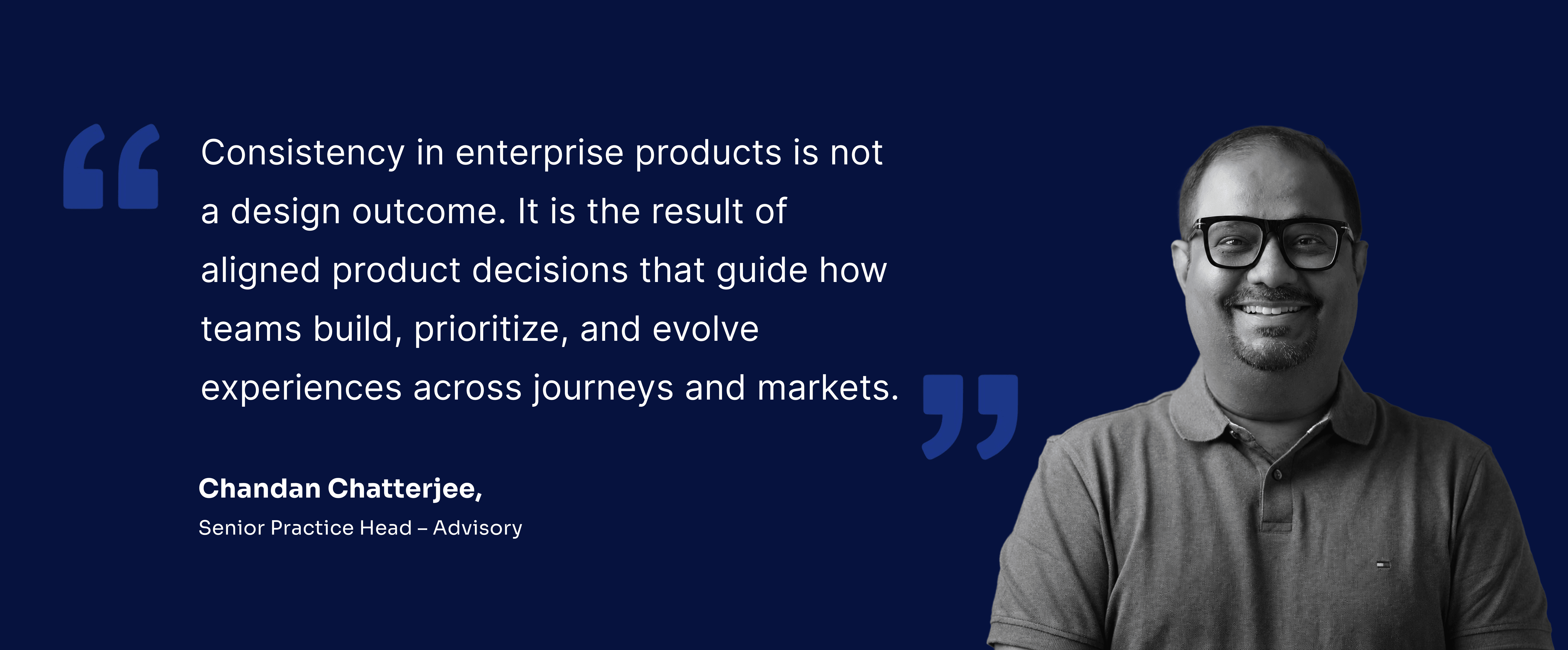
When an organization makes a significant platform choice, it is not making a technology decision in isolation. It is setting the ceiling for every roadmap that follows, determining which customer journeys become possible, which capabilities can be shipped at speed, and where the product will eventually hit a wall.
The enterprises that get this right make platform decisions the same way they make product decisions: by starting with what the product needs to do for customers over the next five years, then working backwards to the architecture that supports it. The choice between modular and distributed systems, between integrated and headless approaches, between centralized and federated data structures, these are not questions for engineering alone. They shape what the business can build, how quickly it can respond to the market, and how much of its engineering capacity gets consumed by maintenance rather than progress.
When Discovery+ scaled its European live sports platform to support approximately one million concurrent users during the UEFA Champions League Final, the technical choices were made in service of a specific product outcome: zero downtime during the moments that mattered most to subscribers. Auto-scaling infrastructure, distributed load balancing, and layered caching were not selected because they were architecturally elegant. They were selected because they were the right answer to a specific product question at a specific scale. The platform held. The product delivered on its promise.
That alignment between product intent and platform decision is what separates infrastructure that enables growth from infrastructure that constrains it.
When a legacy platform is modernized, the organization is making a choice about what the product can become for the next five years. That distinction matters enormously, and most enterprises do not make it explicitly enough.
Treating migration as a technical project is how organizations end up with cleaner code and unchanged commercial capability. The platform is modern. The product opportunity is identical to what it was before. The engineering team has worked hard and delivered nothing the business can use.
The right framing is different. Migration is a product strategy moment, one of the few occasions where an organization can fundamentally reset what is possible. The architecture of the new platform becomes the foundation for every roadmap decision that follows. Getting that foundation right requires product thinking from the outset, not as a layer applied after the technical decisions have been made.
When Titan, India's leading lifestyle company, migrated from a legacy commerce platform to Salesforce, the brief to Robosoft was not to migrate the existing product. It was to build the product the business needed next. Virtual try-ons, live video with store associates, personalized loyalty programs: these were product requirements defined before the architecture was chosen, not features added afterwards. Robosoft's role was to keep product and engineering aligned to the same outcomes throughout.
The result was a 10x improvement in API response times, a 99 percent crash-free session rate, and an 84 percent increase in conversion rate. The technology performed because the product decisions came first.
A roadmap without outcome accountability is a statement of intent. At enterprise scale, intent is not enough.
Connecting every initiative to a specific, measurable outcome changes the relationship between the product team and the rest of the business. It shifts the conversation from what are we building to what is it producing, and it makes the absence of an expected outcome something worth investigating rather than explaining away. The feedback loop between what ships and what it delivers is the mechanism that keeps product decisions grounded in reality rather than assumption.
The timing of this matters as much as the principle. Organizations that define success metrics after a product launches are working with signals that arrive too late to influence the next cycle of decisions. The teams that close this loop most effectively define what they are trying to move, and how they will know they have moved it, before the first line of code is written.
At enterprise scale, that discipline is what separates a roadmap that compounds value over time from one that requires justification every quarter.
Most enterprises have a product strategy. The harder question is whether they have the product management approach to execute it consistently, across every team, market, and stakeholder, without losing coherence as complexity grows.
Technology, design, and engineering are the inputs. Product management is the system that brings them into focus and keeps them there.
Robosoft has spent three decades at the point where product strategy meets engineering delivery. The enterprises we work with are not looking for a document or a handover. They are looking for a partner who can hold product thinking and engineering rigor together as the product grows.
If that is the challenge you are navigating, we would welcome the conversation.
Let’s discuss: [email protected]

By Siddhartha Singh
Siddhartha Singh is a Principal Digital Consultant at Robosoft, where he brings over 14 years of expertise in driving product strategy, development, and digital transformation. Having led initiatives across the media, telecom, technology, and automotive sectors at organizations such as Warner Brothers Discovery, India Today, Vodafone Idea and Volvo, he is an expert voice in shaping product and business outcomes.

RESOURCES
By Manish Kumar Babul

By Abhishek Hegde

By Abhishek Hegde
Engineering
Human
Experiences
Let’s get in touch
We craft intuitive digital products that blend user-centric design with robust technology. From UX/UI to full-stack development, we help brands turn ideas into scalable solutions.